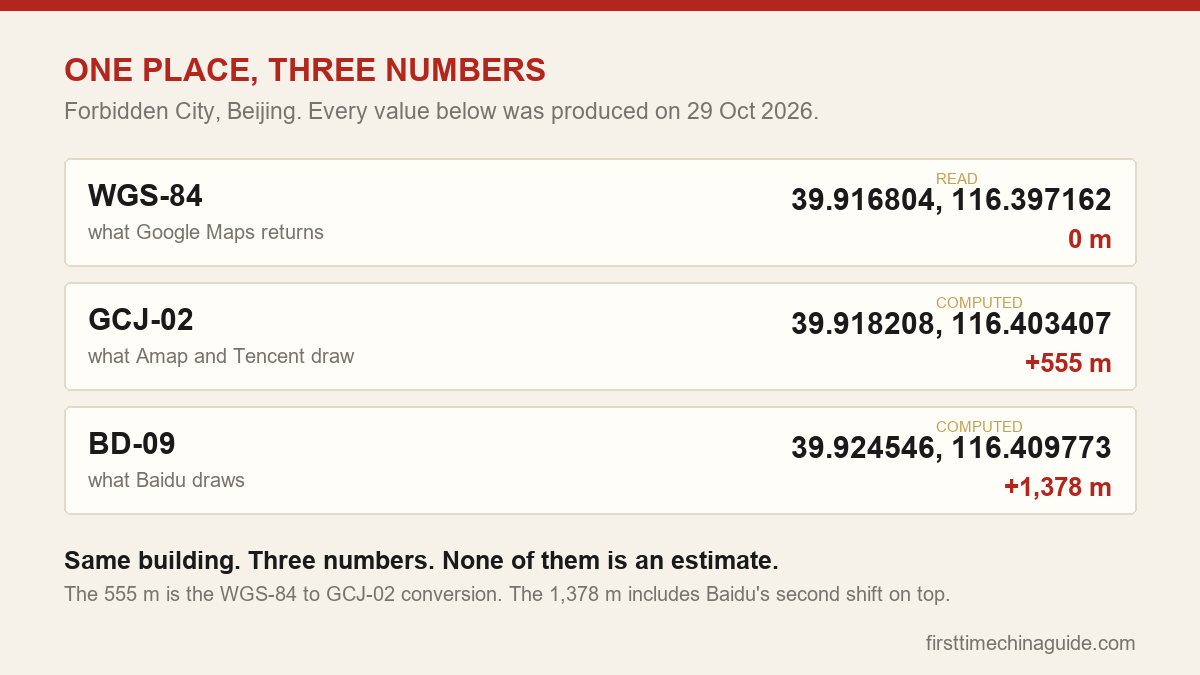
Short answer: Google Maps works in China in the narrow sense — the app opens, it draws streets, it finds the museum. What it will not do is agree with the map you are actually going to navigate on. It returns WGS-84 coordinates; Amap and Tencent Maps draw on GCJ-02; Baidu draws on BD-09. At the Forbidden City the same place comes out 555 m apart. That figure is a conversion you can recompute in a spreadsheet, not a rumour, and the table below is built so you can check it.
Two numbers run through this page and they are not the same measurement, so fix them here before anything else. 555 m is the WGS-84 to GCJ-02 conversion difference at the Forbidden City: the distance between one point and that same point after the public GCJ-02 algorithm is applied. 545 m is the distance from the coordinate Google Maps actually returns for the museum to the GCJ-02 point of the centre used as a reference. The two differ by ten metres because Google’s pin sits 56.1 m from that reference centre — measure the same shift between a different pair of points and the answer moves a little. Both figures were computed on 29 October 2026. Both are in the downloadable table. Neither is an estimate.
The query is one question, but people mean three, and the answers do not match each other.
Public maps in China are published on an encrypted datum rather than on the raw GPS datum. The result is GCJ-02: take a WGS-84 coordinate, run it through a fixed offset function, and you get a second number describing the same place. Amap and Tencent Maps draw on it. Baidu applies a further polar transform on top of it and calls the result BD-09.
Google applies neither. Ask Google Maps for the Forbidden City and it hands back WGS-84 (the raw GPS number) which is precisely the number a Chinese map app will misread.
None of this is secret. The offset function is published in a dozen open-source libraries, implementations agree with each other to within about a metre, and it takes two arguments: latitude and longitude. What is not published is the official definition of the transform, so treat the metres here as “what the public algorithm gives” rather than “what the official transform would give”. At this latitude and longitude the two agree to within a few metres, which is the only reason the numbers are worth printing.
The five-point table, the formula behind every computed cell and a downloadable version for eleven cities live on the coordinate reference page.
!3d and !4d are the coordinate. On 29 October 2026 it read 39.916804, 116.397162.If your numbers land within a metre of mine, stop trusting this article and start trusting your own sheet. That is the point of publishing the arithmetic instead of the conclusion.
555 m is 1,821 ft, or 0.34 mi, or about seven minutes at a normal walking pace. In central Beijing that is one long block. The shift runs east-north-east here, so a pin pasted from Google into Amap lands 555 m west-south-west of the marker Amap already has for the same building: a different gate, a different queue, a different side of the moat.
The failure is quiet. A shifted pin does not look broken — it looks like a plausible address one street over. There is no error message and no “location not found”, just a dot sitting on a real road outside a real wall, and you walk to it. If you are going to the palace itself, the ticket rules and the entry gate are on the Forbidden City ticket page; the point here is that no ticket page can help you if your map put you at the wrong corner of a 72-hectare rectangle.
BD-09 is not another name for GCJ-02. It is a second shift applied on top of it. Take the same Google coordinate through both and it ends up 1,377.6 m from where it started. Baidu’s own step accounts for 889.7 m of that, measured from the GCJ-02 point — and it does not point the same way. The first shift runs at a bearing of 74° and Baidu’s runs at 38°, so the two displacements combine as vectors, not as numbers: 1,377.6 m, not the 1,444.7 m you get by adding them. That is no longer one block. At that distance you are in a different set of streets, and the address you were given does not exist at the pin.
So the practical ordering is: Amap costs you 555 m, Baidu costs you 1,377 m, and both costs are avoidable for free.
There is no one-tap import of a Google Maps list into Amap — that is a separate problem with a separate page. The 48-hour setup covers what to install, in what order, and what to do about offline packs. If your connection is the part that worries you rather than the coordinates, the eSIM page deals with which data plans actually route out of the country.
Three comments from r/chinalife, thread “Google Maps Updated for China”, 20 August 2026. Quoted as written; the vote counts are what the thread showed when I read it on 29 October 2026.
“Alignment may be good but the data is still old Looking at SZ metro its way outdated I wouldn’t trust it in my commute Reviews are disabled as well” — 109 votes
“Why on Earth would you use Google Maps over Amap? Even if the satellite view is aligned the data is way out of date” — 92 votes
“I’m a Google Maps fanboy but I’d never trust them in China for getting around aligned or not” — 28 votes
Not one of the three is about metres. All three are about the age of the data, which is the second half of the answer: even with the datum handled, Google’s China layer is thin and stale and Amap’s is not. The people who live there have already made the trade.
And from r/travelchina on 25 October 2026, on moving a saved list between apps:
“This is the third time after you posted that I have seen this asked” — 10 votes
“You can copy the Chinese address from Google Maps and paste it into Amap Worked very well for me I didn’t find a way to import my whole list of places” — 1 vote
That second comment is the entire method in one sentence, from somebody who worked it out at a desk before flying: the address survives the move, the coordinate does not, and the bulk import has no solution.
Yes, if your traffic leaves the country — roaming SIM, eSIM with a foreign route, or a network that tunnels out. No, on a local connection, where Google’s domains do not resolve to anything usable. What you get either way is a map with old China data and a coordinate on the wrong datum.
Because two datums describe the same place with two different numbers. Google returns WGS-84; Amap reads those numbers as GCJ-02 and draws them where they fall, which at the Forbidden City is 555 m east-north-east of the museum’s own marker. The distance is a function of latitude and longitude, not a fixed number you can subtract everywhere.
Amap. It has the current China data, it has the bus and subway layers, and it does not need a tunnel. Its weak point is the English interface, which is thinner than the Chinese one — the trade-offs are covered in the metro and subway guide.
Not in one action. The name-by-name route works because a place name is not tied to a datum; the coordinate route fails by 555 m a pin. Budget one evening for a two-week trip, or build the list in Amap from the start.
No, and that is the point of the second paragraph on this page. The dot on Google’s own map is close to correct; the 555 m appears when a coordinate crosses between Google and a Chinese app. Two different failures, two different fixes. One of them you can compute, the other you cannot.
All distances and coordinates on this page were produced on 29 October 2026. Nothing here is estimated; anything I could not read or compute is listed under “what this page did not verify”.
Practical first-trip China guides — visas, VPN, eSIM, Alipay, trains, and city routes.