Short answer: five day trips work from Guangzhou, and they split by how you leave the city rather than by distance. Foshan and Shunde are metro rides with nothing to book. Shenzhen and Zhuhai are high-speed rail, booked the day before. Kaiping is rail plus a road leg and eats the whole day. Hong Kong is not on the list for anyone who entered on the 240-hour transit rule, because leaving to Hong Kong ends that entry rather than pausing it.
Most guides rank these by how far away they are. That is the wrong axis. What decides a day trip is the return leg, and whether the thing you came to see is open when you arrive.
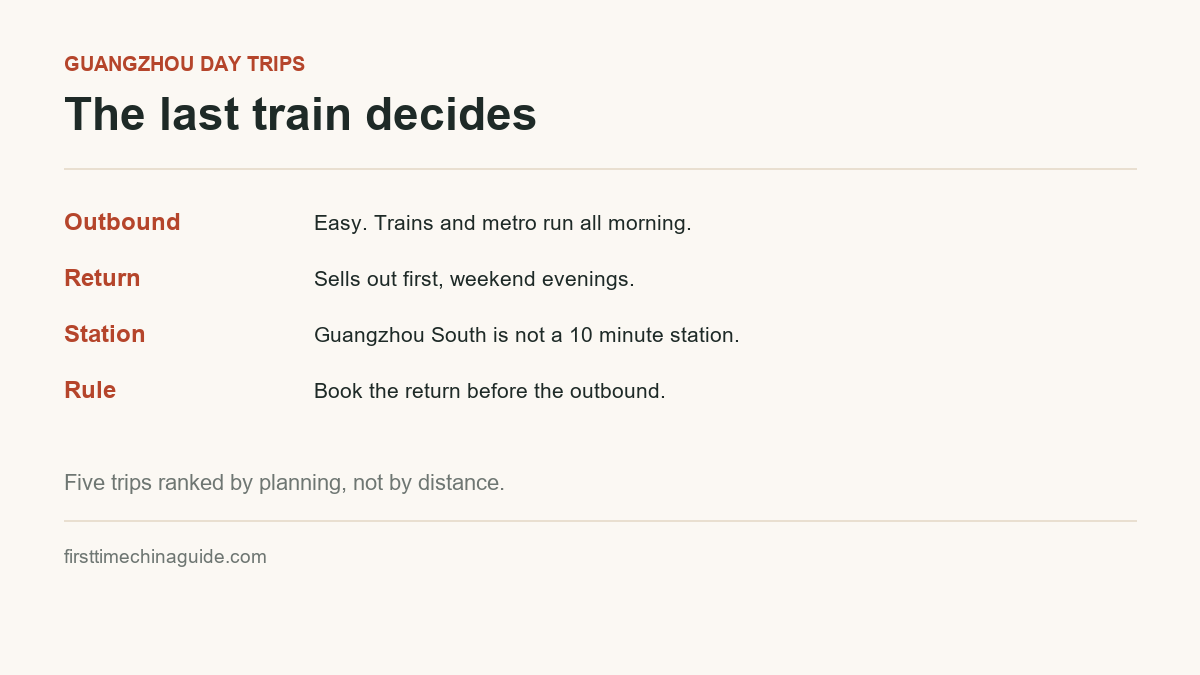
Outbound is never the problem. Trains leave Guangzhou South all morning, and a metro line runs every few minutes until late. The return leg is where day trips fail, for two reasons that have nothing to do with distance.
First, the return sells out before the outbound does. On a weekend, the 18:00 to 20:00 block back into Guangzhou South is the first thing to go, because everyone who went out in the morning wants the same three trains home. If you book only one direction in advance, book the return.
Second, Guangzhou South is not a station you can arrive at ten minutes before departure. It is one of the largest stations in the country, security is at the door, and the walk from the metro to a departure gate is measured in minutes, not seconds. Treat the departure time as the time you should already be inside, and the station as the thing that eats the last forty minutes of your day.
If you entered China on the 240-hour transit visa-free rule, your permitted stay area is fixed at entry, and for a Guangdong entry that area is Guangdong Province in full, with exits available at all open ports across the province (National Immigration Administration, read 30 October 2026). That covers every destination on this page except one.
Hong Kong and Macau are separate immigration areas. Going there is not a domestic day out, it is leaving the country, and on a transit entry the return is a fresh entry rather than a continuation. So for a transit visitor the Hong Kong train is the last leg of the trip, not a loop in the middle of it. The rail detail for that leg, including fares and frequency, sits in the Guangzhou guide rather than here.
The same rule works in your favour in one direction: West Kowloon Station Port is itself an eligible port for the transit rule, so the train from Hong Kong into Guangzhou can be the entry, not just the exit.
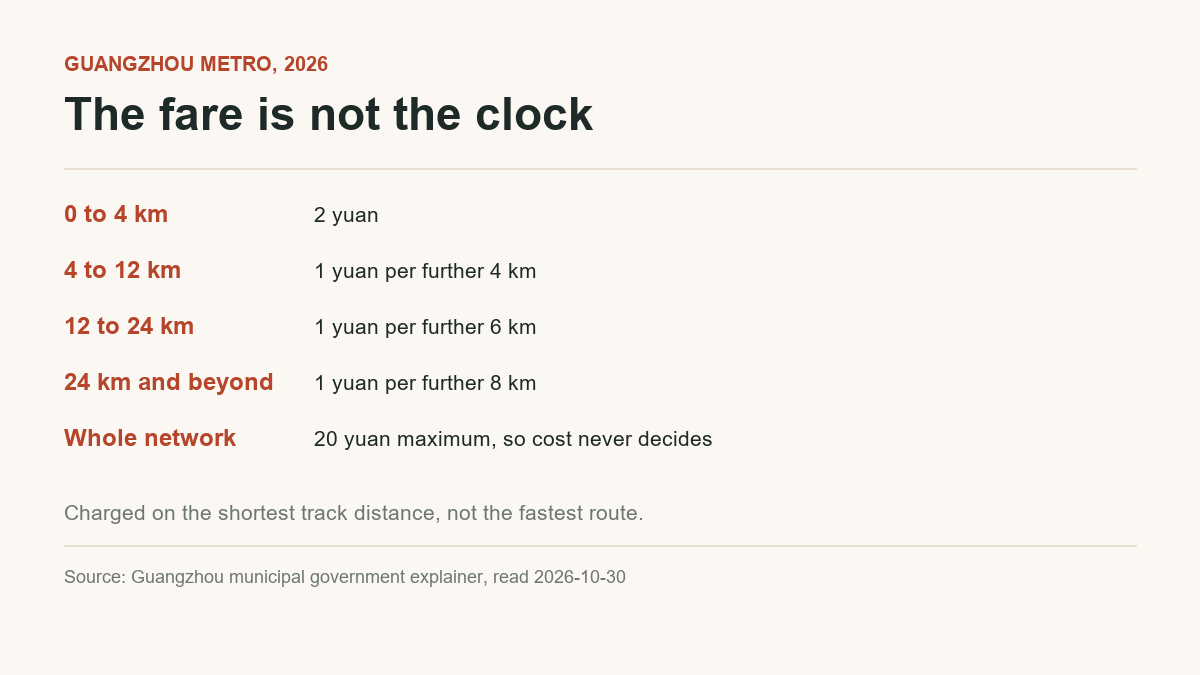
Guangzhou metro fares are charged on the shortest track distance between your two stations, not on the number of stops and not on straight-line distance, and the city’s own explainer is explicit that the cheapest path is not necessarily the fastest one (Guangzhou municipal government fare explainer, read 30 October 2026). The bands:
| Shortest track distance | Fare |
|---|---|
| 0 to 4 km | 2 yuan |
| 4 to 12 km | 1 yuan for each further 4 km |
| 12 to 24 km | 1 yuan for each further 6 km |
| 24 km and beyond | 1 yuan for each further 8 km |
| Any trip on the network | 20 yuan maximum |
| APM line | 2 yuan flat |
Two things follow that no competitor page states. The first is that the whole network is capped at 20 yuan, so no metro day trip on this list can cost more than 20 yuan each way no matter how far you go. Cost is not the variable on a metro day trip, time is. The second is that because the fare follows the shortest track distance, a route that looks cheaper can be the slower one, and a fare you paid tells you nothing about how long you sat on the train. Plan metro trips by the clock, not by the price.
| Day trip | How you leave the city | What you must book | Cost shape |
|---|---|---|---|
| Foshan | Metro, cross-city line | Nothing | Metro fare, 20 yuan cap applies |
| Shunde | Metro plus a local bus or taxi | Nothing | Metro fare plus a short local hop |
| Shenzhen | High-speed rail from Guangzhou South | Both directions, passport number | Rail ticket plus metro at the far end |
| Zhuhai | High-speed rail from Guangzhou South | Both directions, passport number | Rail ticket plus local transport |
| Kaiping | Rail, then road | Rail plus a plan for the last leg | Rail ticket plus a car or bus |
Foshan is the only trip on this list that needs no decision the night before. You get on a metro line that crosses into the neighbouring city, and you are in the old centre without a ticket, a passport check or a timetable. That is the whole reason to put it first: on a trip where something else has already gone wrong, this is the day out that still works.
The old quarter is compact. The ancestral temple, the arcaded streets and the pottery workshops sit within walking distance of each other, which makes it a half-day of walking and a half-day of eating rather than a list of sights to tick. Because the metro runs late, the return leg costs you nothing in planning: you leave when you are done, not when a train says so.
What to check on the day: which exit you want at the station nearest the old quarter. The exits are far apart at street level, and picking the wrong one turns a two-minute walk into a fifteen-minute one in the heat.
Shunde is where Guangzhou goes to eat, and it is reachable on the metro, but not to the door. The metro gets you into the district and then a short bus or taxi ride gets you to the streets worth walking. Budget for that hop and the trip stays simple; pretend the metro arrives at the restaurant and you will spend an hour standing on a road.
This is a day built around two meals and a walk between them. Dairy desserts, raw fish, and the slow-cooked dishes that the region is known for are the reason to come, and the correct strategy is to eat early, walk, then eat again. Restaurants here run on local hours, so a late lunch is a real risk: the good rooms fill and then close between services.
What to check on the day: whether the place you picked serves through the afternoon. A restaurant that closes at two is not a place to arrive at half past one.
Shenzhen is the fastest way to see what the last forty years did to this part of the country, and it is a rail trip, not a road trip. You leave from Guangzhou South, you arrive at a station inside the city, and the rest is metro. Nothing about the day requires a guide.
The reason to go is the contrast rather than a single sight: the newer city centre against the older fishing-village edges, and a waterfront that did not exist a generation ago. It is also the trip that most rewards an early start, because the things worth seeing are spread across two or three districts and the metro between them is the real clock.
What to check on the day: that you booked the return, not just the outbound. This is the route where the evening trains fill first, and standing in a station at seven in the evening with no ticket is the standard way this day trip ends badly.
The station choice on this route is the whole decision, because Shenzhen has five arrival stations and the last train back leaves each of them at a different time. The departure times, fares and last trains are on Guangzhou to Shenzhen by train.
Zhuhai is the day trip for someone who wants the coast rather than another city. The rail line runs south from Guangzhou South, and the point of the place is the waterfront, the long promenade, and the view of the bridge that crosses to Hong Kong and Macau.
It is also the calmest of the five. There is no single attraction that must be queued for, which makes it a good choice on a public holiday when everything else in the province is full. The trade is that the day is about atmosphere rather than a checklist, and if you need a sight to justify the train, this is the wrong pick.
What to check on the day: the weather, because this is the one trip on the list that is genuinely ruined by rain. The others have interiors to fall back on. This one does not.
Kaiping is the reason to leave the Pearl River Delta’s cities at all. The Diaolou are multi-storey defensive village towers built by families whose money came back from overseas, and they are a fusion of Chinese and Western structure and decoration that exists nowhere else in this form. The World Heritage listing covers four groups of towers, with twenty of the most symbolic ones inscribed, under criteria that name the interchange of architectural styles and the local tradition of tower building that ran from the Ming period (UNESCO World Heritage Centre, read 31 October 2026).
That word “groups” is where the day trip goes wrong. The listing is not one site with one gate. It covers four separate groups of towers spread across the Kaiping countryside, so a ticket does not mean a single location, and a plan built on “see the Diaolou” without picking a group turns into a day in a car. Decide which group you are going to before you buy the train ticket, then arrange the last leg around that one place.
This is also the trip where the last leg is the whole problem. The rail gets you into the area, and then it is road. Without a plan for that leg you will lose the middle of the day to figuring it out at the station, and the towers are not within walking distance of each other.
What to check on the day: which group you are heading to, and how you are getting from the station to it. Everything else about Kaiping is easy once that is settled.
Specific rail departure times for Shenzhen, Zhuhai and Kaiping were not read from the operator’s timetable for this page, so no times are printed. Fares for those three routes are not printed either, for the same reason. Ticket prices and opening days for the Foshan ancestral temple, the Shunde restaurants and the individual Kaiping tower groups were not read from official pages, so they are absent rather than estimated. The 240-hour transit rules quoted above were read from the National Immigration Administration on 30 October 2026, and the metro fare bands from the Guangzhou municipal government explainer on the same day. If a number is not in this page, it is because it was not confirmed, not because it was unimportant.
Which is the easiest day trip from Guangzhou? Foshan. Metro only, nothing to book, and the return does not depend on a timetable.
Can I do Hong Kong as a day trip? Yes on a normal visa. Not on a 240-hour transit entry, because leaving to Hong Kong ends that entry instead of pausing it.
Do I need to book trains in advance? Book the return leg at minimum. The evening trains back into Guangzhou South sell out before the morning ones out.
Is a metro day trip expensive? No. The whole Guangzhou network is capped at 20 yuan per trip, so cost is never the reason to skip one.
Which one should I drop if I only have one free day? Kaiping if you want the thing you cannot see anywhere else, Foshan if you want the day that cannot go wrong.
For the city itself, including what the metro does inside Guangzhou and what a night on the river costs, start with the Guangzhou travel guide. If you are still deciding where to sleep between these trips, the area guide picks the neighbourhood by what you came for. And if you are arriving on the transit rule, read the transit visa-free page before you book anything, because the stay area decides which of these trips you are allowed to take.
Practical first-trip China guides — visas, VPN, eSIM, Alipay, trains, and city routes.