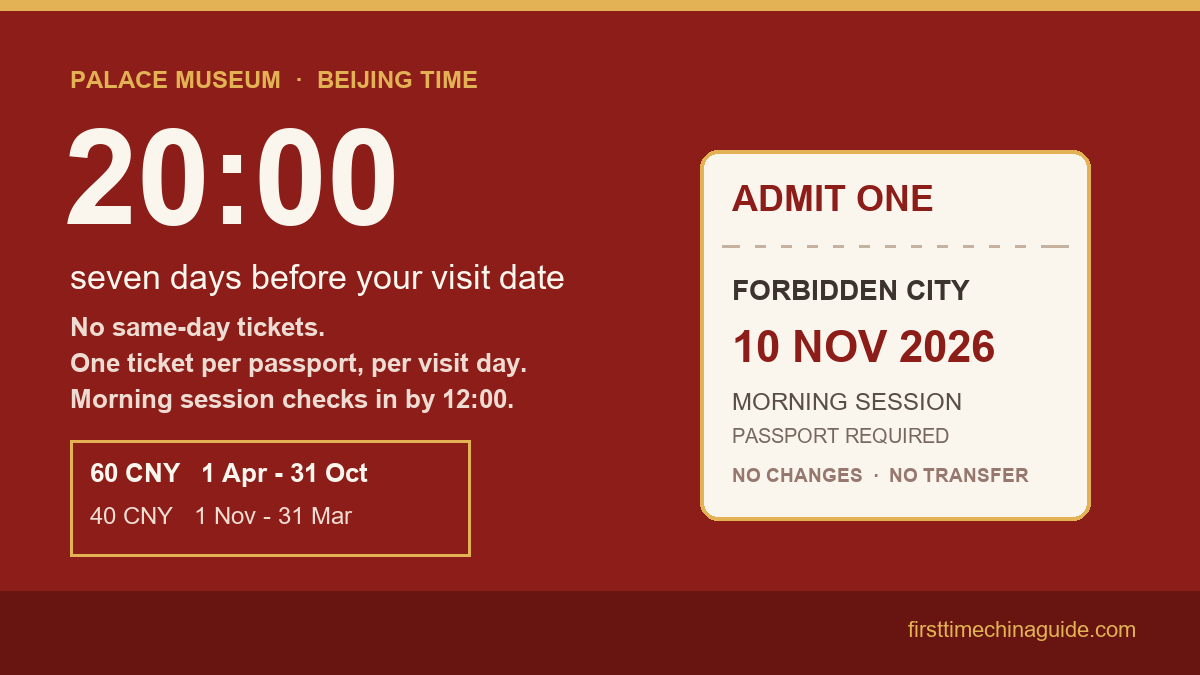
Short answer: Forbidden City tickets cost 60 CNY from 1 April to 31 October, and 40 CNY from 1 November to 31 March. They are sold online only — the museum states plainly that it does not sell same-day tickets, so there is no window to walk up to on the day. Sales open at 20:00 Beijing time exactly seven days before the visit date; a passport is an accepted document for non-mainland visitors; and the two official channels are the museum’s own booking site and its own mini-program.
Everything below is what the museum’s own pages say, plus the points where the pages that rank for this search get it wrong.
Prices are set by season, not by day of week, and the two paid galleries inside the palace are priced separately.
| Item | Peak season 1 Apr – 31 Oct |
Off season 1 Nov – 31 Mar |
|---|---|---|
| Main entrance ticket | 60 CNY | 40 CNY |
| Treasures Gallery | 10 CNY | 10 CNY |
| Clocks and Watches Gallery | 10 CNY | 10 CNY |
Two things worth knowing about that table. The gallery tickets are add-ons: you buy them alongside the main ticket, and they are not covered by the free-admission categories that apply to the main gate. And the museum’s visit page states that these prices were fixed under 2002 Beijing municipal price-bureau documents, and lists the pricing supervision phone numbers next to them — which is why the numbers have not drifted the way hotel and train prices have. Source: the museum’s own visit page, read 28 October 2026.
This is the single fact that decides whether a first trip to Beijing works or not. Tickets for a given day go on sale seven days earlier at 20:00 Beijing time. A visit on 10 November becomes bookable on 3 November at 20:00 Beijing time — not at midnight, not on the morning of, and not on a rolling basis.
Three consequences that are easy to miss:
The day is split into two sessions, and each session has a hard gate on when you may pass the check. Morning tickets must be checked in by 12:00; afternoon tickets cannot be checked in before 11:00. That one-hour overlap is the whole flexibility you get.
In practice this makes the morning session the one to take if you want the two extra galleries and a slow walk north, and the afternoon session the one to take if you are arriving on a morning train. It also means a late lunch near the east gate can cost you the morning slot entirely.
The museum sells and checks by real name. Mainland Chinese visitors can only use their identity card; everyone else (including visitors from Hong Kong, Macao and Taiwan, permanent residents, and foreign passport holders) books and enters on the travel document they will physically carry that day.
So the document number you type at 20:00 is the document that gets scanned at the gate. If you renew a passport between booking and travel, or if you book under one passport and carry a second one, the ticket will not check. Carry the exact document you booked with, and carry it in the same form (a passport card is not a passport book).
The museum’s booking notice says it has not authorised any third party or individual to act as a ticket agent, and asks visitors to use its own channels. That warning is repeated on two of the seven English pages we read for this piece — so it is not a secret, it is just buried. What is worth your attention is that some of the pages ranking for this search describe the visit rules inaccurately, in ways that would cost you a morning:
Entry is at the Meridian Gate on the south side, and the visit runs one way: you finish at the Gate of Divine Prowess on the north side, or leave by the east gate. You cannot enter from the north, and you cannot walk back south through the palace to exit where you came in.
Here is the part that almost never appears in English guides, and it is the reason people miss their session: the Tiananmen area is laid out for one-way movement from south to north. If your only booking is the Palace Museum, the museum’s notice tells you to reach the Meridian Gate entrance along the east or west river roads rather than pushing through the square. If you have also booked Tiananmen Square, you queue at the square’s security checkpoints and approach from the south. Turning up at the square without a square reservation, expecting to walk straight through to the palace gate, is the most common way to lose an hour.
Beyond the Monday closure, one gallery is out of action. A notice dated 27 August 2026 on the museum’s site says that Yanxi Palace will be closed for a conservation survey from 1 September to 31 October 2026 and will reopen on 1 November 2026. None of the seven English pages we read mentions this. If Yanxi Palace is on your list (and it is, for anyone who watched the palace dramas) it is not open again until November.
Cancellation has a clean cut-off and a penalty clock, and both matter because the ban applies to future bookings, not just to this one:
Partial cancellation is the fiddly case: if one person in a group cannot come, the museum asks you to handle it before check-in, either through the original channel or at the service window at the Meridian Gate, which is open 08:30–16:00 in peak season and 08:30–15:30 off season.
The museum uses face-recognition equipment to speed up real-name checks. Its notice states that the facial data is used only for a live comparison and is not stored. If that is a problem for you, staff can handle the check manually — the notice points you to on-site staff rather than to an opt-out form.
You need to book in advance. The museum does not sell same-day tickets at all, so there is no gate window to fall back on. The advance window opens at 20:00 Beijing time seven days before the visit date.
No. The notice requires the original document used at booking, and the check is by real name against that number.
Not normally. It closes all day every Monday except on statutory public holidays. Plan Beijing so the palace falls on a Tuesday to Sunday, and put the Great Wall or a hutong day on the Monday.
At opening, 08:30, if you have a morning ticket and want the quieter halls first. If you have an afternoon ticket, do not arrive before 11:00 — you will be held outside the check.
If this is your first trip and you are still deciding where to sleep relative to the palace, our Beijing travel guide covers the areas, and the metro route to the Meridian Gate is in our China metro guide. For the wider planning sequence, start from the China travel guide for first-timers.
Practical first-trip China guides — visas, VPN, eSIM, Alipay, trains, and city routes.