Short answer: yes, Guangzhou is worth visiting, and this Guangzhou travel guide is built around the two days most people actually have. The reason to come is food plus a harbour history no other Chinese city can offer. This Guangzhou travel guide is written for the traveller who lands with two days and wants to know what things cost and when they open, not what a rooftop bar looks like at sunset. The city was the country’s trading door for centuries, so it reads as a port first and a monument second: arcaded streets that stay walkable in the rain, a river that still carries barges, and a skyline that went up in a single generation. One thing to settle before you book anything is which airport terminal you fly into, because that changed this year and most guides online still describe the old arrangement.
Every figure below carries a source type and a read date. Metro fare rules come from a Guangzhou government explainer published in August 2025. Airport terminal and shuttle details come from a government transport notice published on 4 May 2026, read again on 30 October 2026. Museum hours and prices come from the operator and from a government museum listing, which is a stronger class of evidence than a booking site. Cross-border rail times and fares come from the operator’s own trip planner on the day of writing. Where a number could only be read a day earlier, the row says so instead of pretending it was checked twice.
Guangzhou (historically Canton) sits on the Pearl River where it turns brackish, and the city’s shape still follows the water. The old quarter in Liwan is a grid of arcaded shopping streets built for monsoon rain, with the Chen Clan Academy as its carved-stone centrepiece. Shamian Island next door is a former foreign concession: an open neighbourhood rather than a ticketed attraction, with banyan avenues and the consular buildings still standing. East of that, Zhujiang New Town is glass towers, the opera house and the tower on the south bank. The language you hear is Cantonese before Mandarin, the food is the reason many people come, and the whole thing is compact enough that the metro ties it together in twenty-minute hops.
What that means in practice is that Guangzhou rewards walking in short bursts rather than long marches. Pick one quarter per half day, ride between them, and let the air conditioning of a teahouse be part of the plan. The city is also the most useful base for the region: Hong Kong is a train ride away, Foshan is a metro ride away, and the airport is a hub rather than a stopover.
This is the section that dates every other guide. Until May 2026, Baiyun Airport worked the way the blogs describe: T1 for most domestic carriers, T2 for the rest, a metro station under each. Then, from 7 May 2026, the eleven domestic airlines based in T1 moved to T3, and T1 closed for renovation and stopped handling passengers. The metro station at the airport’s T1 and the intercity station beside it closed with the building. If a guide tells you to take the metro to the airport’s south station for a domestic flight, that guide predates the move.
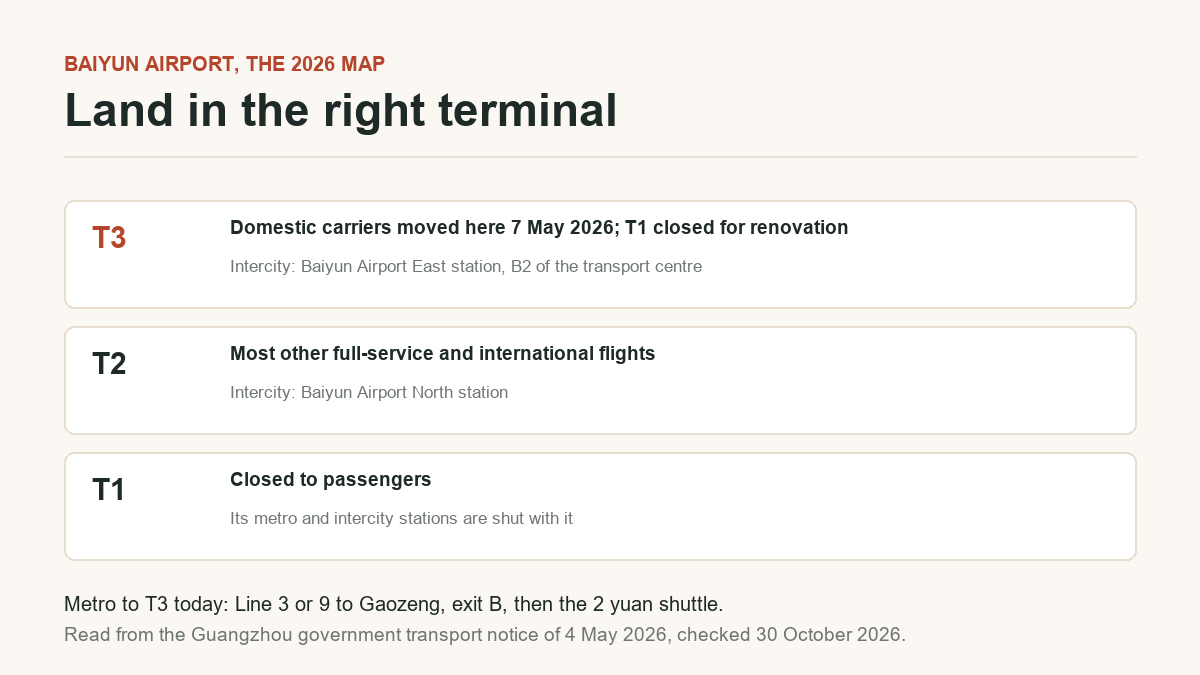
What works now, in the order most travellers will use it. By intercity rail, the East Ring line runs to Baiyun Airport East station, which sits on the second basement level of the T3 transport centre, three to five minutes’ walk from the terminal. The same line stops at Baiyun Airport North station, which serves T2. The naming is the part people get wrong: East is T3, North is T2, and there is no station called T1 any more.
By metro, the connection to T3 is a two-step: ride Line 3 or Line 9 to Gaozeng, leave by exit B, and take the airport shuttle branch line from the kerb outside. The shuttle takes about fifteen minutes, costs 2 yuan, accepts the local Yangcheng Tong card, and leaves every five to ten minutes. For T2 the metro still works directly. Airport buses run from eight city districts to T3 from 19.9 yuan, which is the option to know if you are staying somewhere the metro does not reach with luggage. Between terminals, T2 to T3 has a transfer shuttle that takes about twenty-five minutes and runs around the clock, but it is for connecting passengers only, so do not plan on it as public transport. The airport’s own hotline is 020-96158, and the one habit worth building is checking the terminal letter on your ticket before you leave the hotel, not at the kerb.
If you are arriving without a visa at all, under the 240-hour transit rule rather than a tourist visa, two details from this section are the ones that matter: Baiyun is one of the ten eligible ports in Guangdong, and the province is your permitted stay area rather than the city. The visa-free transit page lists the ports and the ways out, including the one that leaves by train.
Guangzhou Metro is large, bilingual, and priced by distance rather than by station count. The rule is not the straight line between your two stations: the system prices the shortest track path, which is why two journeys of the same length can cost the same while a shorter-looking one costs more. The bands, as published by the city, are simple once you see them written down.
| Distance travelled | Fare |
|---|---|
| 0 to 4 km | 2 yuan |
| 4 to 12 km | 1 yuan for each further 4 km |
| 12 to 24 km | 1 yuan for each further 6 km |
| 24 km and beyond | 1 yuan for each further 8 km, up to a 20 yuan maximum |
| APM line, Zhujiang New Town | 2 yuan, flat |
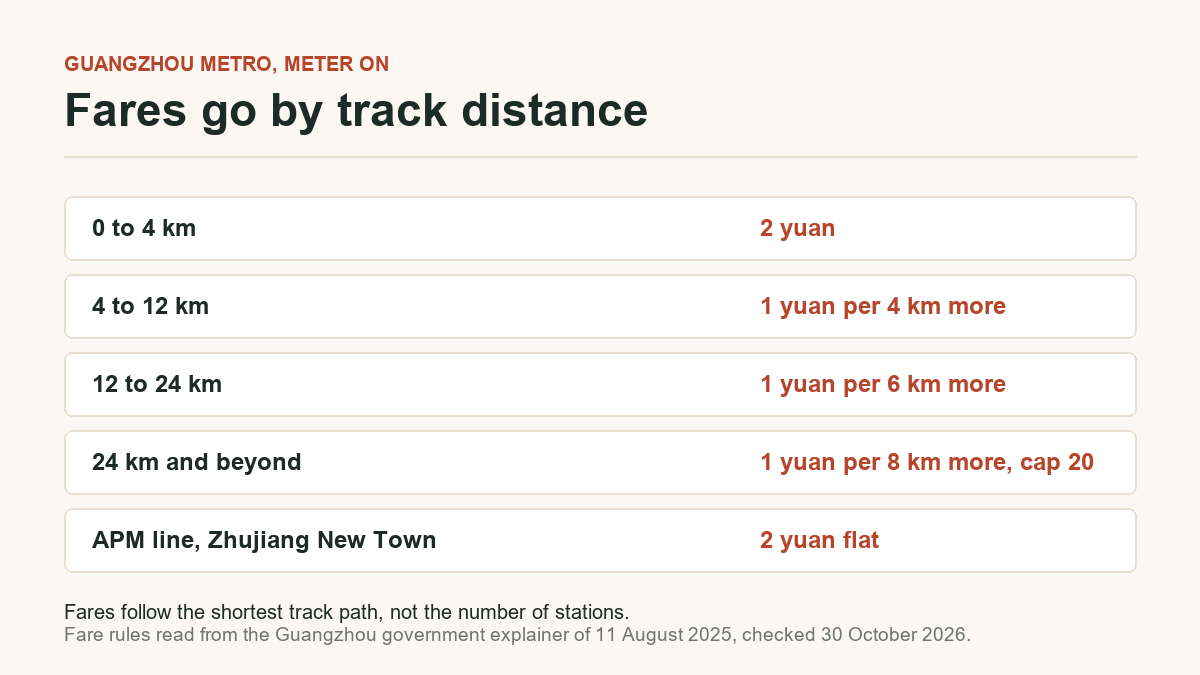
Two practical notes. The APM line, the two-car people mover under Zhujiang New Town, is a flat 2 yuan and is genuinely useful for the tower and the opera house rather than a novelty. And paying at the gate is where foreign cards hit a wall: the machines want coins or a local card, while the gates read the QR code in Alipay or WeChat Pay once a foreign card is attached. Set that up before you fly, because doing it at the gate with a queue behind you is the worst possible classroom. The steps are on how to pay in China.
Fares, the 270 minute limit inside the paid area, and which line reaches which airport terminal are collected in one place in the Guangzhou metro guide.
Navigation is the other half of the metro problem. Google Maps draws the streets but its coordinates sit on a different datum, so the pin lands a block off in the old lanes. Amap is the app locals use, and the offset reference behind the mismatch is on this page, with the app setup on the maps page. If you were thinking of hiring a Guangzhou tour guide, the honest answer for the sights below is that they are all on the metro and signposted in English; the money is better spent on a food walk in Liwan with someone who orders for you.
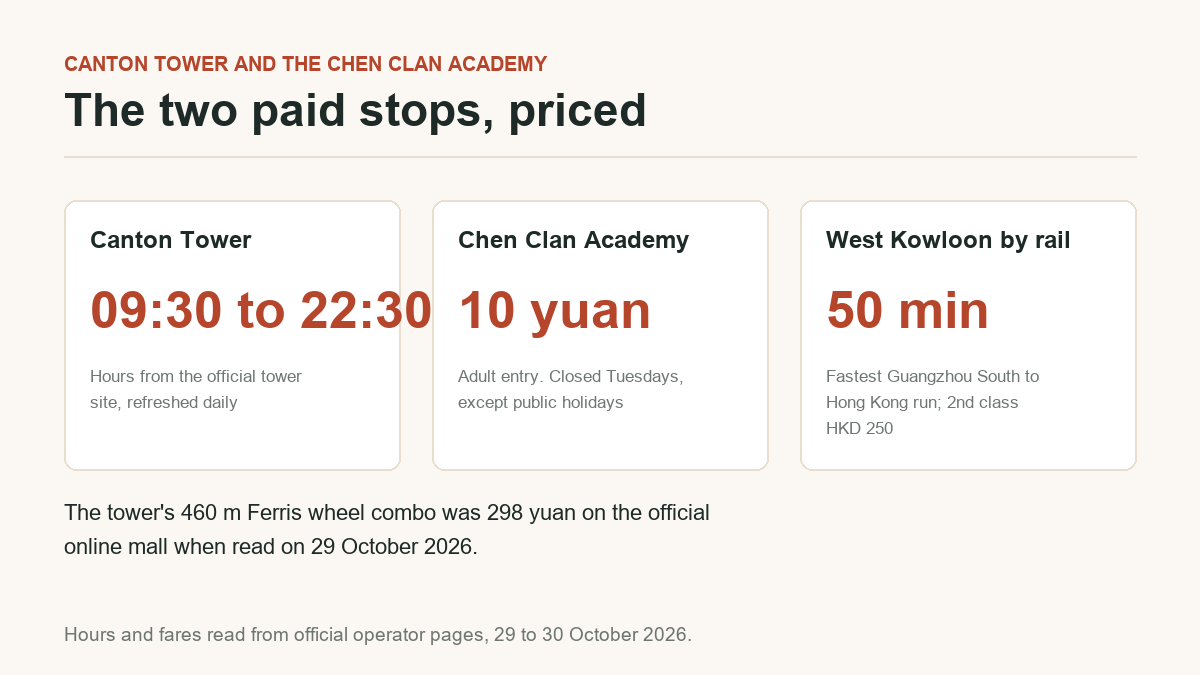
The Chen Clan Academy, also signposted as the Guangdong Folk Art Museum, is the single best hour in the city if you care about craft. It was built as a clan school and it is now a museum of carving, porcelain and embroidery, with the roof ridges doing most of the talking. Entry is 10 yuan for an adult, 5 yuan for students and for visitors aged 60 to 64, and free for children under 1.2 metres and for visitors over 65 with ID. It sits on Zhongshan 7th Road in Liwan, close to the metro.
Two timing traps. The academy closes on Tuesdays except statutory holidays, so a Tuesday in Guangzhou should be planned around something else. And its hours move with the season: from 16 October to 14 April it opens 09:00 to 17:30 with last entry at 17:00, while from 15 April to 15 October it stays open to 18:00 with last entry at 17:30. Tickets are booked through the museum’s own WeChat account up to seven days ahead, and the ticket desk number is 020-81819653. Arrive at opening if you want the courtyards without a tour group in them.
Yuexiu Park is the free counterweight: 06:00 to 22:00, last entry 21:30, with the Five Rams statue and the Zhenhai Tower on the ridge inside it. It is a park people actually use, which is the point: morning tai chi, retired men with songbirds in cages, and a view over a city that has rebuilt itself twice. Take Line 2 to the park’s own station and walk uphill.
Shamian Island is the third stop and costs nothing because it is not an attraction: it is a residential block of colonial-era buildings under banyan trees, with a river promenade at the western end. Go late afternoon, walk the length of the central avenue, and cross back to the old town for dinner. It is also the best place in the city to sit still for twenty minutes, which a two-day trip usually needs by the second afternoon.
Canton Tower opens 09:30 to 22:30, hours the operator publishes on its own site and refreshes daily, and the building caps admissions at 22,000 people a day. The paid experiences are sold as separate products rather than one ticket: the indoor observation decks, the 450 m and 488 m outdoor platforms, the 460 m Ferris wheel that runs around the roof, and the drop ride at the top. The Ferris wheel combo was 298 yuan per person on the operator’s own online mall when it was read on 29 October 2026, and the same listing showed 298 again on 2 November 2026 with the five other priced products beside it, all visible without a login. Canton Tower tickets, six products and which one to buy is worked out on its own page, with the Monday hours and the counter rule that decide it.
Two things worth knowing before you queue. The tower is on the south bank, so the view that matters is back towards Zhujiang New Town, which means the best light is late afternoon into dusk rather than midday. And the ticket categories are not interchangeable: buying the cheaper indoor deck does not get you onto the Ferris wheel, and upgrading at the top costs more than buying the right product at the bottom. If the queue is long, the river promenade below the tower gives you the same skyline for nothing.
If you want the skyline from the water rather than from 460 metres up, the river cruise is the other paid view, and it is the one place in this city where nobody can quote you a single price. The operator side of the market runs three piers, Dashatou, Tianzi and the Canton Tower Fortune Pier, and each pier has its own boats with their own deck tiers, so the fare you hear depends on which of those you name.
The clearest numbers I could pull on 30 October 2026 came from one operator’s booking site. A boat leaving Tianzi Pier at 18:55, 20:15 and 20:50 was listed at a 90 yuan discount fare, and a boat leaving Dashatou at 19:20, 20:30 and 21:40 at 108 yuan, both for the lowest deck.
Treat those as an entry band rather than a tariff, for two reasons. The deck you pick is priced separately and I did not get the upper deck or private room figures. And the booking pages carrying those two numbers still show a 2023 header with no year attached to the price itself, so what is listed is an operator’s discount fare, not a published schedule. The Canton Tower’s own river section lists the boats and the tower plus cruise product without publishing a price at all, which is why the range stays a range.
What that means at the pier: you will be asked which deck you want before you are told a price, so decide that first. If the number matters more than the boat, buy at the pier or through the operator’s mini program rather than a reseller, because a reseller price and the boat you actually board are not always the same thing.
The resort publishes a real ladder for one park. On 30 October 2026 the official ticket page listed Chimelong Paradise at 250 yuan for a standard adult, 200 yuan for a youth and 175 yuan for a child, a senior or a concession category, with children under three years old or under 1.0 metres free when one adult brings one child.
The safari park and the circus do not appear there as single park prices. They appear bundled, which is the useful part: a two park two day ticket covering Chimelong Paradise and the safari park was listed at 510 yuan standard, 480 yuan youth and 420 yuan for a child, a senior or a concession, and Paradise plus the circus in a standard seat at 595 yuan.
The page also defines its own peak days, and this is where a budget goes wrong. New Year, Spring Festival, Qingming, May Day, Dragon Boat, the whole summer block from 1 July to 31 August, Mid Autumn, National Day, the Halloween event period, New Year’s Eve, every Saturday and Sunday and any special event day all count as peak, and everything else counts as an ordinary day. The ticket page splits its bundle prices into an ordinary day column and a peak day column for exactly that reason.
One rule worth knowing before you book: since 24 November 2020 the resort has admitted visitors by scanning the identity document used at booking. The notice is written for Chinese identity cards, so a foreign visitor should carry the passport the booking was made under. The ticket page also labels its own list as a reference, with what is actually on sale on the day deciding.
Guangzhou South to West Kowloon is the most useful train in southern China and it runs like a metro: 37 departures on the day this was checked, first at 06:32, the fastest at 50 minutes and most between 50 minutes and an hour and a quarter. Second class costs 250 Hong Kong dollars for an adult on the fare table effective 30 October 2026, with first class at 400, premium at 450 and business at 750. Tickets are priced in renminbi and the Hong Kong dollar figure is adjusted monthly with the exchange rate, so the number you pay depends on the month you buy in.
Practically, that makes Hong Kong a day trip rather than a separate leg, and it works in the other direction too: land at Baiyun, spend two nights in Guangzhou, then take the train south instead of a second flight. Immigration happens at West Kowloon, so budget time at the far end rather than the near one, and book through the operator or the national rail app with your passport number, the same way as any other Chinese train. The train booking page covers that process step by step. For the trips that stay inside Guangdong, including the two you can do on the metro without booking anything, the day trip guide ranks them by how much planning each one needs, and the Shenzhen leg has its own page because the station you pick changes the day: Guangzhou to Shenzhen by train.
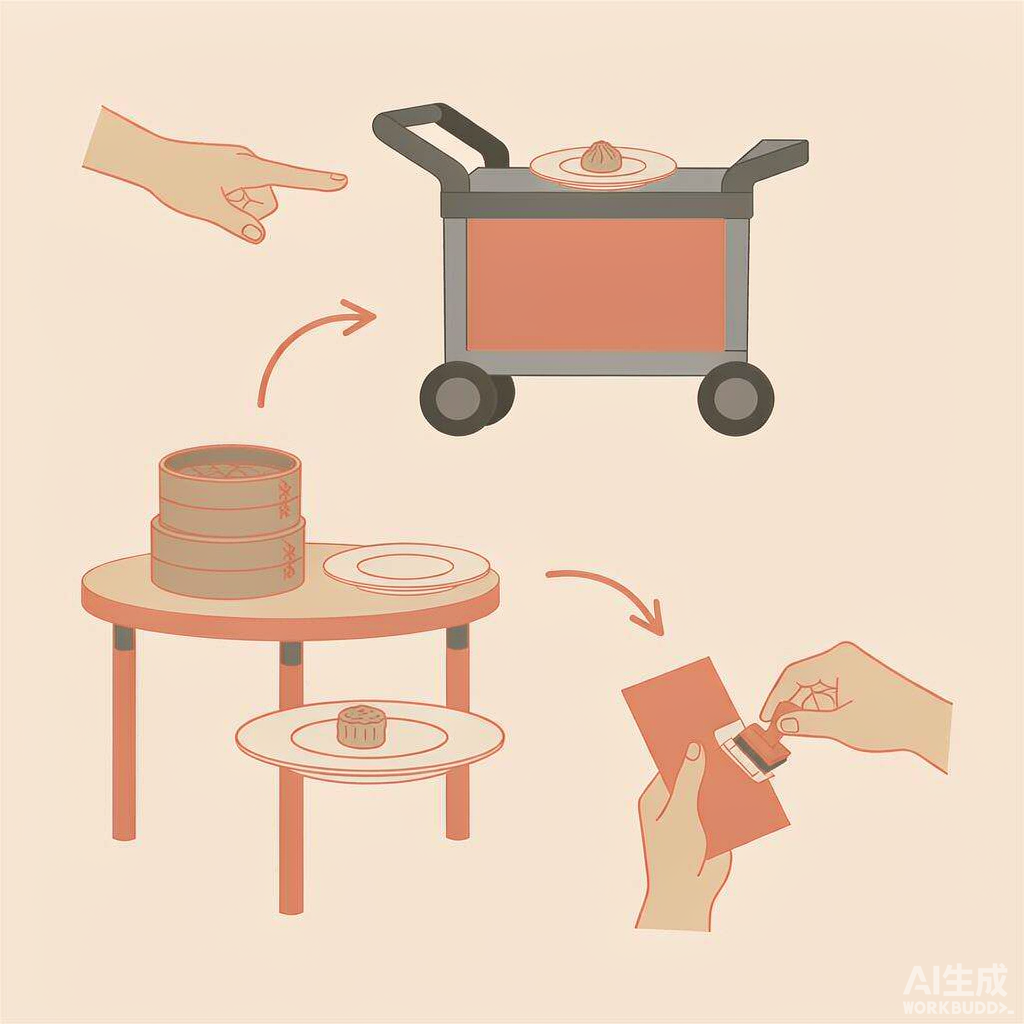
Yum cha is a morning institution, not a lunch, and the good rooms fill by half past nine on a weekend. Order by pointing at what the trolley or the neighbouring table has rather than working through a translated menu: har gow, siu mai, cheung fun, char siu bao and a pot of tea is a complete first round, and you can add from there. The bill is tallied by stamping a card on your table, so nobody is guessing at the end.
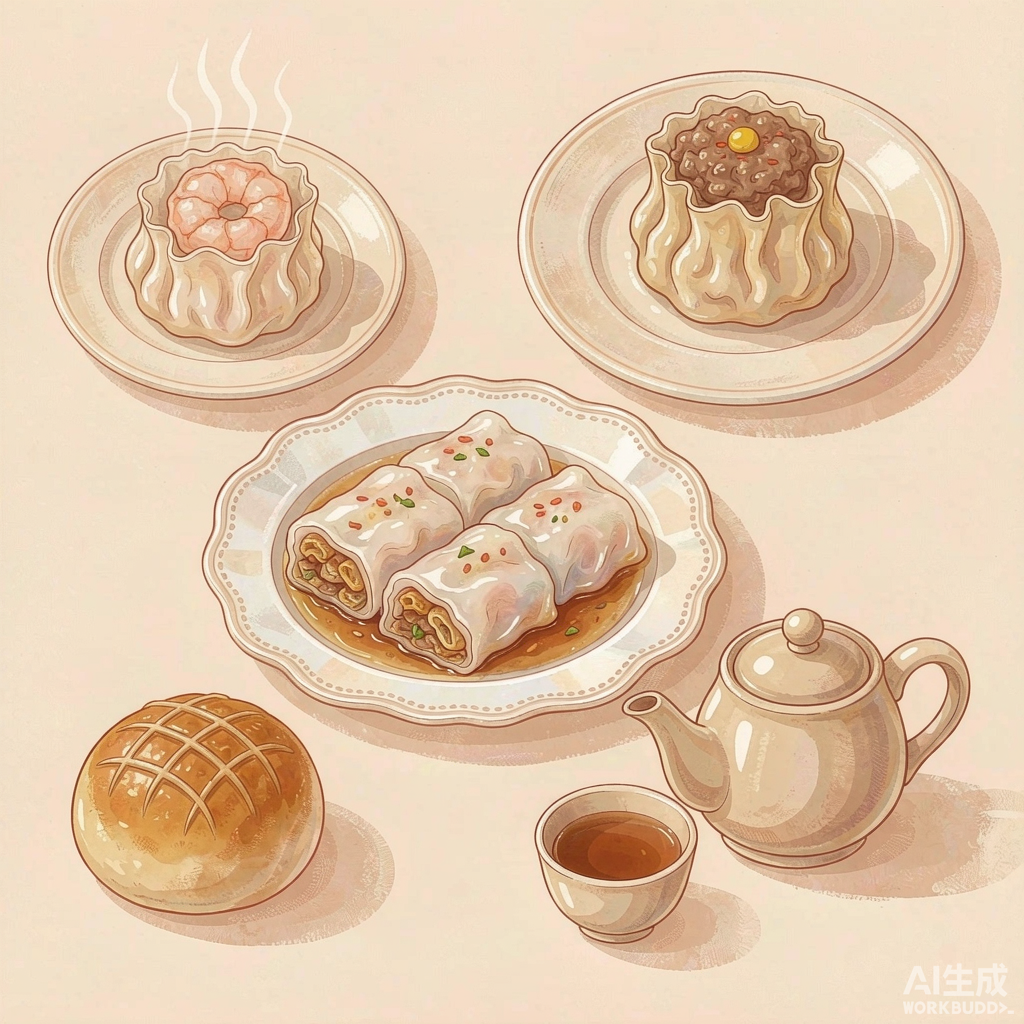
What each of those is, so the pointing lands: har gow is a steamed shrimp dumpling in a thin pleated wrapper; siu mai is an open-top pork dumpling, often with a dot of shrimp; char siu bao is a steamed bun filled with barbecue pork; cheung fun is a steamed rice noodle roll, plain or with shrimp or beef, dressed in light soy. After that first round the usual additions are egg tarts (custard in flaky pastry), lo bak go (pan-fried turnip cake) and lor mai gai (sticky rice steamed in a lotus leaf).
Two things have shifted since the old guidebooks. The trolley is no longer everywhere: in many Guangzhou rooms the carts have been replaced by an order pad or a QR code at the table, and the dishes come from the kitchen instead of rolling past. And a per-person tea charge is standard – it sometimes shows as its own line on the bill rather than on the menu, so check before you treat the menu price as the whole cost.
One custom is worth knowing: when someone tops up your teapot, tap two fingers on the table – it is the usual thanks and saves a word.
Most rooms take Alipay or WeChat Pay at the table; the metro is the fastest way into Liwan and Yuexiu for a morning session, and tourist-heavy rooms may also take a card, but do not count on it.
Do I need to book? Usually not for a weekday morning. For a weekend or a public holiday the known rooms fill before ten, so go early or expect to wait.
Is dim sum only Cantonese? It started in Cantonese-speaking Guangdong and is now served across China, but Guangzhou is where the form is deepest – the room, the carts, the morning timing all begin here.
What if I cannot read the menu? Point at a neighbouring table’s basket, or at the trolley as it passes. English menus exist in the tourist districts but are unreliable; the point-and-look method works in every room.
Outside the teahouse, the two things to eat are roast meat over rice, ordered by pointing at the hanging birds in the window, and wonton noodles in a clear shrimp-broth, which is a different dish from the Beijing and Sichuan versions. Liwan and Yuexiu have the highest density of both, and the rule that works is the queue rule: a shop with a line of locals at eleven in the morning is a shop worth joining. English menus exist in the tourist lanes and the food there is usually a grade below the street behind it. If you want the wider map of regional cooking, what to eat in China covers how the south differs from the north.
Guangzhou is subtropical and humid, and the honest summary is that summer is a wet sauna: June to September brings heavy rain and the typhoon season, and the city occasionally shuts transport down for a day when a typhoon passes. October to December is the comfortable window, dry and warm, and March to April is mild but drizzly. The arcades exist because of this climate, so use them.
The crowding variable is not the weather but the Canton Fair, which runs twice a year and fills the hotels in Haizhu and the metro at the exhibition centre. The fair dates page has the three phases and the gaps between them, and where to stay in Guangzhou sorts the districts by what each one costs you that week. Read both before you book a room, because rates move sharply and there is no point pretending otherwise. Public holidays concentrate the crowds at the tower and in the teahouses, and the Tuesday closure at the Chen Clan Academy catches people out on short trips, which is why it is repeated in the table below. When to visit Guangzhou takes the four variables apart one at a time, with the flood season dates, the heat thresholds and the fair windows taken from the official documents rather than from a temperature table.
| Place | Price | Hours | Closed | Source type |
|---|---|---|---|---|
| Metro, 0 to 4 km | 2 yuan | Operator timetable | None | Municipal explainer |
| Metro, 24 km and beyond | 1 yuan per 8 km, maximum 20 yuan | Operator timetable | None | Municipal explainer |
| APM line, Zhujiang New Town | 2 yuan flat | Operator timetable | None | Municipal explainer |
| Canton Tower | 298 yuan for the 460 m Ferris wheel combo | 09:30 to 22:30 | None | Operator site and official mall |
| Chen Clan Academy, adult | 10 yuan | 09:00 to 17:30, last entry 17:00 (16 Oct to 14 Apr) | Tuesdays, except statutory holidays | Government museum listing |
| Chen Clan Academy, peak season | 10 yuan | 09:00 to 18:00, last entry 17:30 (15 Apr to 15 Oct) | Tuesdays, except statutory holidays | City listing |
| Chen Clan Academy, student or age 60 to 64 | 5 yuan | As above | Tuesdays, except statutory holidays | Government museum listing |
| Yuexiu Park | Free | 06:00 to 22:00, last entry 21:30 | None | City listings |
| Shuttle, Gaozeng metro to T3 | 2 yuan | Every 5 to 10 minutes | None | Government transport notice |
| Airport bus from city districts to T3 | 19.9 yuan and up | Operator timetable | None | Government transport notice |
| Guangzhou South to West Kowloon, second class | 250 HKD | 37 trains a day, first at 06:32, fastest 50 minutes | None | Operator trip planner |
| River cruise, lowest deck, Tianzi Pier boat | 90 yuan discount fare | 18:55, 20:15 and 20:50 | None | Operator booking site |
| River cruise, lowest deck, Dashatou boat | 108 yuan discount fare | 19:20, 20:30 and 21:40 | None | Operator booking site |
| Chimelong Paradise, standard adult | 250 yuan | Park hours set by operator | None | Operator official ticket page |
| Chimelong Paradise, youth | 200 yuan | Park hours set by operator | None | Operator official ticket page |
| Chimelong Paradise, child, senior or concession | 175 yuan | Park hours set by operator | None | Operator official ticket page |
| Chimelong, two parks two days, standard | 510 yuan | Park hours set by operator | None | Operator official ticket page |
| Chimelong Paradise plus circus, standard seat | 595 yuan | Park hours set by operator | None | Operator official ticket page |
Download the same table with the source URL and read date on every row: guangzhou-prices-and-hours-2026-10-30.csv. Each row is marked read or computed, so you can see which numbers came off a page and which were added up.
The metro bands are the easiest of the lot, because the city publishes them with an explanation of the shortest-path rule and the APM exception. The airport terminal mapping is the one that changes fastest: the 4 May 2026 notice is the primary document, and the airport’s own site should be your second check if your trip is months out. The Chen Clan Academy publishes seasonal hours and the Tuesday closure on its own site and in the government museum listing, and the price list including the 5 yuan concessions sits in the same listing. The tower publishes hours daily but sells through a logged-in mall, so treat any price in a blog as a snapshot. The rail fares are published monthly in Hong Kong dollars and priced in renminbi, so the figure you see is the figure for the month you buy.
On the river cruise I got the lowest deck discount fares from one operator and not the upper deck or private room prices, and I could not reach the official mini program price at all, so the cruise rows are an entry band rather than a full range. On Chimelong I got the one park that publishes a full ladder plus the bundles, but not single park prices for the safari park or the circus. I did not check hotel rates, which move weekly and move hard during the Canton Fair. I did not verify this year’s Canton Fair session dates, which is why the text tells you to check the calendar instead of quoting dates. I did not visit any of these places in person for this page, so nothing here is a first-hand report of a queue or a plate of dumplings: the numbers are read from pages, and the pages are named. And I could not re-read the tower’s ticket price on the day of writing because the official mall now requires a login before it shows products, so that one number carries a 29 October date and is labelled as such.
Yes, and the pair works better than two separate trips: the train from Guangzhou South to West Kowloon takes about an hour, so two nights here and three there is one itinerary rather than two flights. Guangzhou is the food and the old port, Hong Kong is the harbour and the hills, and they do not repeat each other.
Two full days covers the Chen Clan Academy, Shamian, Yuexiu Park, the tower at dusk and one serious morning of dim sum. One day is enough only if you pick food over monuments. Three days adds a day trip, and Hong Kong by rail is the one that needs no planning.
Carry a few hundred yuan for metro machines, small noodle shops and anywhere the QR fails, and set up Alipay or WeChat Pay with a foreign card before you fly. Guangzhou is more card-friendly than smaller Chinese cities, but the teahouse bill and the taxi are still QR first.
From T3, take the intercity to Baiyun Airport East and ride it into the city, or take the shuttle to Gaozeng and join Line 3. From T2, the metro is direct. Either way you end up on Line 3 towards the centre, and the tower has its own stop on the line plus the APM connection.
If what you actually wanted was a Guangzhou itinerary rather than a guide, the two days in the short answer are the itinerary and the table above is its bill. Next stop on this route: its own page here.com/china-city-guides/hong-kong-things-to-do/”>Hong Kong, an hour south by rail and a completely different set of problems. The city guides hub has the rest, and if you are still sorting out data and payments, start with the eSIM page before you land.
Practical first-trip China guides — visas, VPN, eSIM, Alipay, trains, and city routes.