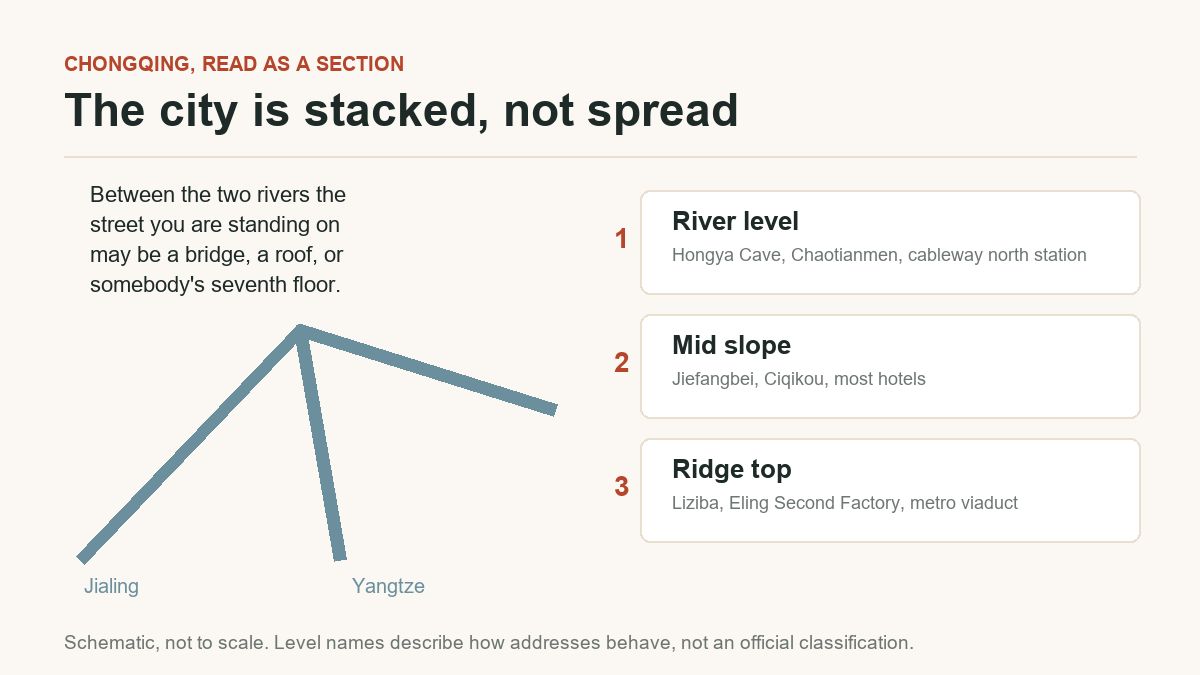
Short answer: give Chongqing two full days, not one. One day buys you Hongya Cave lit up at night and a metro ride you did not understand. Two days buy the shape of the place: a peninsula between the Yangtze and the Jialing, a monorail that runs through a residential block at Liziba, a cableway over the river at 30 yuan a head, and a metro that will take you anywhere for 2 to 10 yuan. The one thing to fix before you book a hotel is that addresses here have levels. A shop 80 metres from your hotel on the map can sit eleven floors below the street you are standing on.
Every figure on this page carries a date and a source type, because prices here move and because some of them are weaker evidence than others. Metro fares and the cableway fare come from municipal notices and the operator. Airport and terminal facts come from the airport article read on 30 October 2026. Attraction prices and opening hours come from operator and booking pages read the same day, which is a weaker class of evidence than a government notice, and the table at the end says so row by row. Where two sources disagreed, both numbers are shown and the disagreement is named.
The old core sits on a ridge with water on two sides. The Jialing arrives from the north-west, the Yangtze from the south-west, and they meet at Chaotianmen at the tip of the peninsula. Roads stack over roads, buildings have entrances on two different streets at different heights, and the metro spends part of its route on a viaduct because tunnelling through the ridge was the harder option. This is the whole reason the city photographs the way it does, and it is also the reason your walking estimates will be wrong. A map measures the horizontal distance. Here you also pay in vertical distance, and the payment is usually a staircase.
Practically: check the entrance level before you leave, not the pin. Amap shows which level an entrance sits on, and the level is the part that decides whether the walk is two minutes or twelve. Our setup page for maps before you fly covers the app side; the datum problem behind it is on this page and the numbers are on the offset reference.
Jiangbei International Airport sits about 19 km north of the centre. Which metro line you want depends entirely on which hall you land in, and the three halls are not interchangeable.
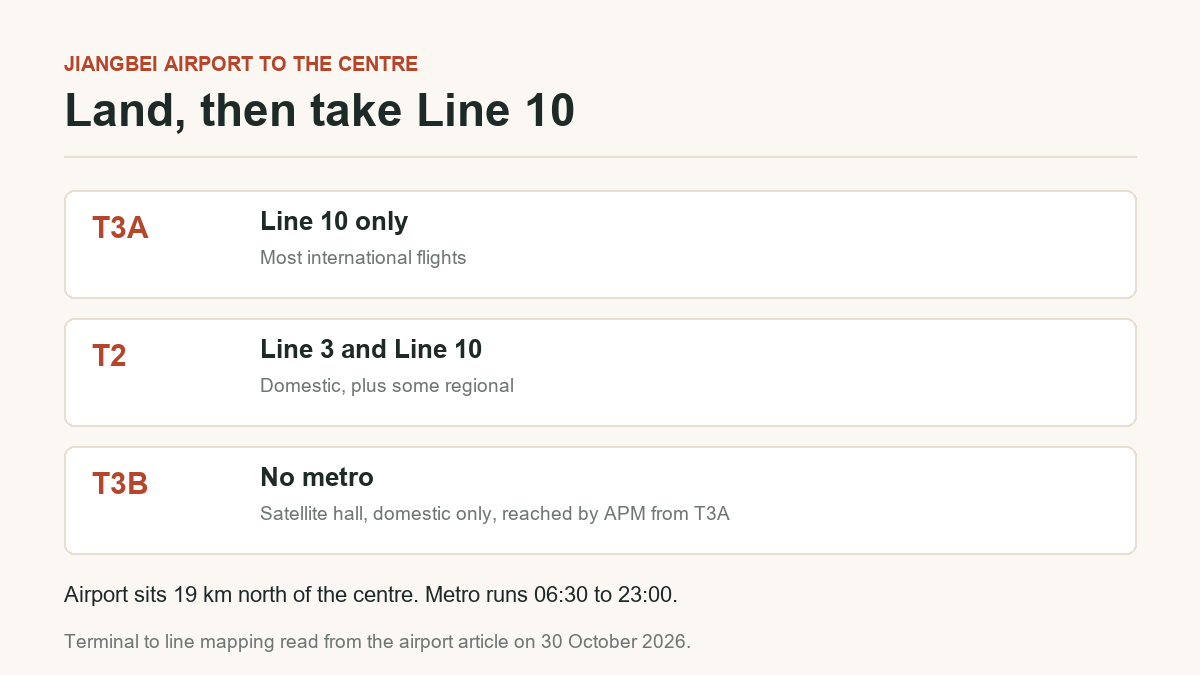
Line 10 reaches both T3A and T2, and it also stops at the North Railway Station, which makes it the useful line for anyone continuing by high-speed train. Line 3 reaches T2 only. T3B is a satellite hall with no metro at all: you check in and clear security at T3A and ride an underground people mover across, and T3B handles domestic flights only while international departures stay in T3A. If your ticket says T3B and you are arriving, you land at T3A first and are moved across, so plan the metro from T3A.
The metro runs from 06:30 to 23:00. A landing after 22:00 leaves you enough time to reach the platforms but not much margin, and a landing after 23:00 means a taxi. Fares are distance based and start at 2 yuan, so the airport run is cheap enough that the taxi decision is about time, not money.
Chongqing Rail Transit runs 12 lines and 324 stations over 574.12 km, on the version of the system article read on 30 October 2026. Two of those lines, 2 and 3, are straddle monorails rather than conventional metro, which is why Line 2 can thread a station through a building and why the ride feels different from anything in Beijing or Shanghai. The fare is banded by distance, and the bands were set by a municipal price notice that took effect on 30 July 2025.
| Distance travelled | Fare |
|---|---|
| 0 to 4 km | 2 yuan |
| 4 to 8 km | 3 yuan |
| 8 to 12 km | 4 yuan |
| 12 to 17 km | 5 yuan |
| 17 to 23 km | 6 yuan |
| 23 to 30 km | 7 yuan |
| 30 to 40 km | 8 yuan |
| 40 to 55 km | 9 yuan |
| 55 km and beyond | 1 yuan for each further 20 km |
Source: the operator’s fare page and the municipal price notice of 25 July 2025, effective 30 July 2025. The same page excludes the two suburban lines, so a trip out to Bishan or Tongliang is priced on a different table.
Paying is the part visitors get stuck on. Single-journey machines take coins and small notes, and the gates read the QR code in Alipay or WeChat Pay, which both accept foreign cards once you have set them up. Do that setup before you fly, not at the gate with a queue behind you: the steps are on how to pay in China.
One habit worth building: read the exit letter, not just the station name. At a station cut into a ridge, exit A and exit C can surface on two streets that do not connect at ground level, and the difference is a flight of stairs and a ten-minute walk.
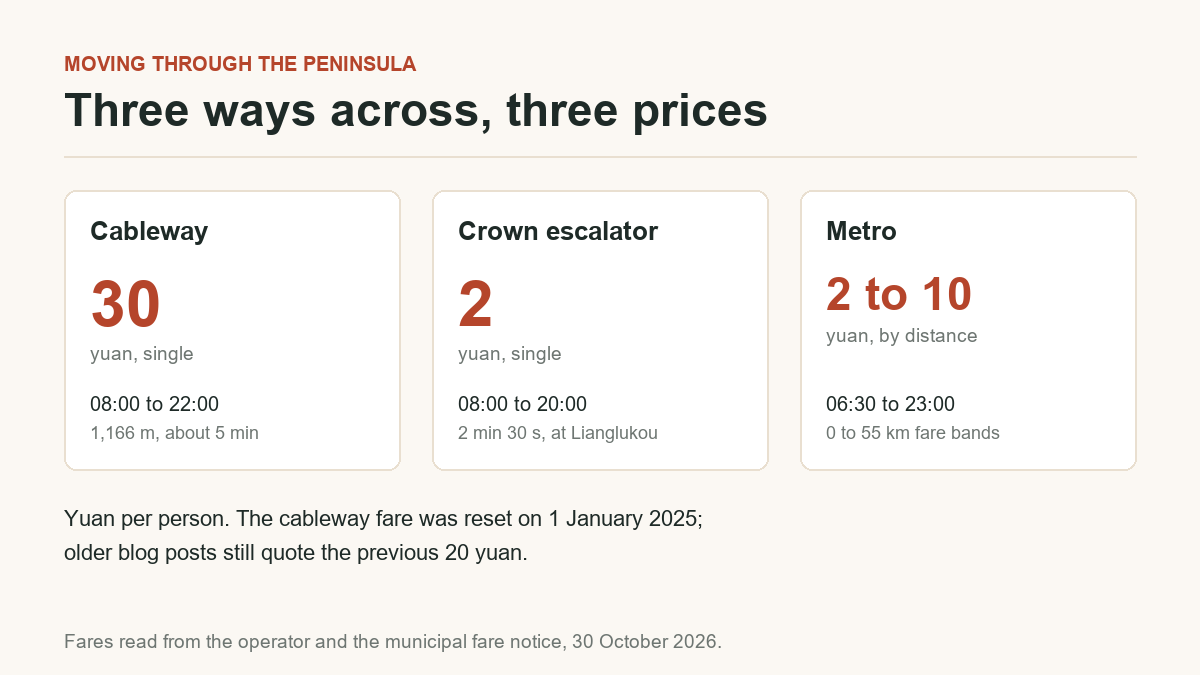
The Yangtze River Cableway is the one most people mean. It runs 1,166 m between the Yuzhong side and the Nan’an side, the crossing takes about five minutes, and each cabin holds 80 passengers plus an attendant. A single ride is 30 yuan and a return is 50, a fare reset on 1 January 2025 under a municipal price approval. Older blog posts still quote 20 yuan, which was the previous fare; check the number you were told against the date on the post. Hours run 08:00 to 22:00 from 1 March to 30 November, 08:00 to 21:00 from 1 December to the end of February, and 07:30 to 22:30 on statutory holidays. The north station is at Xinhua Road 151, a short walk from Jiefangbei and Hongya Cave; the south station is at Shangxin Street 4, by Longmenhao. Tickets are sold through the operator’s WeChat account and at the counter with a passport, and the operator’s number is 023-68816888.
The queue is not symmetric. City media consistently report the south station as the quieter end, so if you only want one crossing, ride it from south to north and take the metro back. That advice is worth more than any timing tip on a blog, because it is about which door you queue at, not which hour you arrive.
The Crown Escalator at Lianglukou is the second crossing and almost nobody lists it as transport. It is 2 yuan a ride, takes 2 minutes 30 seconds, and runs 08:00 to 20:00. It exists because the vertical gap between two roads at Lianglukou was too steep for a footpath, and it is the cheapest demonstration of how this city solves its own terrain. Ride it once, in the direction that saves you the climb.
The third is the metro itself. A cross-river trip on Line 2 or Line 6 costs 2 to 4 yuan and gives you the skyline view without the queue, and the stretch between Liziba and Eling runs high enough that the city opens up on both sides.
Hongya Cave is free and open all day, a stack of eleven floors of stilt-house pastiche built into the cliff above the Jialing. The lights come on in the evening and go off at 23:00; the municipal account announced a 20:00 to 23:00 window for a holiday stretch in June 2026, and city media give 19:30 as the usual switch-on. Either way, arrive half an hour before the lights and you get the change from daylight to lit in one standing position.
Where to stand matters more than when. The inside is a shopping street with a view of other shoppers. The two views worth the walk are from the middle of the Qiansimen Bridge, which puts the whole stack in one frame with the river below, and from the far bank, where you get the reflection. After 22:00 the crowd thins sharply. If someone offers to walk you to a paid viewing spot, decline: the free ones are better and the paid ones are usually a rooftop two streets back.
Ciqikou is free, sits on Line 1, and is best before 10:00, when the teahouses are open and the main lane is still walkable. It is a restored Qing-era river port, which means the lanes are genuine in shape and commercial in content, and the side alleys going up the hill are where the morning actually is.
The Three Gorges Museum is free, opens 09:00 to 17:00 with last entry at 16:30, and closes on Mondays except statutory holidays. It sits on Renmin Road next to the Great Hall of the People, so the two are one stop. Two hours is enough for the Three Gorges gallery and the 360-degree film, and it is the only place in the city where the reservoir story is told with the objects in front of you rather than on a sign.
Dazu Rock Carvings, west of the city, is a UNESCO site and the better half-day of the two if you care about sculpture. A high-speed train from the West Railway Station reaches Dazu South in about 31 minutes for 39 yuan. From the station it is roughly 50 minutes and 70 yuan by ride-hail to the Baodingshan visitor centre, or about two hours and 9 yuan by the local bus pair. Gate prices are 115 yuan for Baodingshan and 70 for Beishan, with a combined ticket at 140 in peak season and 120 in low season; resale listings quote 110 and 58, so treat 115 and 70 as the gate price and anything lower as a channel discount.
Wulong, south-east, is the karst day trip: the Three Natural Bridges are three limestone arches over a valley floor, and the walk is down into the sink and along the bottom. A high-speed train from the North or West station reaches Wulong in about 55 minutes, and a shuttle from the station to the scenic area costs about 15 yuan and takes 25 minutes, running every half hour from 07:40 to 15:30. The gate price is 70 yuan in peak season and 40 in low season, but entry in practice requires the combined ticket that includes the internal shuttle and the lift, at 155 in peak and about 95 in low. Adding the Longshuixia gorge brings it to 195.
Both sets of day-trip numbers come from booking pages and city media read on 30 October 2026, not from a price board at the gate. Budget a margin and confirm at the counter.
Chongqing hotpot is a beef-tallow broth with so much chilli and Sichuan pepper that the surface moves. Order the nine-grid pot if you want to control it: the centre grid boils hardest, so it is for things that cook in seconds, and the corner grids simmer, so they are for things you want to leave alone. Mild is still hot. If you are unsure, ask for the split pot, which gives you a clear broth on one side, and nobody in the room will think less of you.
The dip is sesame oil, garlic and coriander, not peanut sauce. Noodles for breakfast means xiaomian, a small bowl of wheat noodles with chilli oil and peanuts, sold from counters with no English and no menu: point at the bowl the person ahead of you is eating. Offal is standard and good, and the tripe is the thing locals order first.
Summer here is a basin summer: hot, humid, and still in the evening, with the worst of it in July and August. Spring and autumn are the comfortable windows. Rain matters more than temperature, because wet stone steps in the old lanes and on the stair streets are genuinely slippery, and the handrails are not always where you expect them.
Shared bikes barely exist here, and that is not an oversight. Plan on the metro plus walking, wear shoes with grip, and pack light enough that a staircase is an inconvenience rather than an event. National holiday weeks concentrate the crowds at Hongya Cave, Liziba and the cableway at the same hours, and Liziba’s viewing platform has run a one-way flow during peak periods to keep the pavement moving.
| Place | Price | Hours | Closed | Source type |
|---|---|---|---|---|
| Metro, 0 to 4 km | 2 yuan | 06:30 to 23:00 | None | Municipal notice |
| Yangtze River Cableway, single | 30 yuan | 08:00 to 22:00 (Mar to Nov) | None | Operator and price approval |
| Yangtze River Cableway, return | 50 yuan | 08:00 to 21:00 (Dec to Feb) | None | Operator and price approval |
| Crown Escalator, Lianglukou | 2 yuan | 08:00 to 20:00 | None | City transport guide |
| Hongya Cave | Free | All day, lights until 23:00 | None | City media |
| Ciqikou old town | Free | All day | None | City media |
| Three Gorges Museum | Free | 09:00 to 17:00, last entry 16:30 | Mondays, except public holidays | Museum and city listings |
| Dazu, Baodingshan | 115 yuan | Daylight hours | None listed | Booking pages |
| Dazu, Beishan | 70 yuan | Daylight hours | None listed | Booking pages |
| Wulong, Three Natural Bridges | 70 yuan gate, 155 yuan with shuttle and lift | Daylight hours | None listed | Booking pages |
Download the same table with the source URL and read date on every row: chongqing-prices-and-hours-2026-10-30.csv. Each row is marked read or computed, so you can see which numbers were taken from a page and which were added up.
The metro fare bands are published by the operator and by the municipal development and reform commission, and the notice carries an effective date, so it is the easiest of the lot to verify. The cableway fare has an approval date of 1 January 2025 and the operator publishes both single and return prices, which makes a 20 yuan figure in a blog post easy to date as stale. The museum publishes its own opening hours and closure day. The airport terminal-to-line mapping is the one number that changes with construction, so check it against the airport’s own site if your trip is more than a few months out. Day-trip prices are the weakest row in the table, and the gate is the only authority.
I did not price the two-rivers night cruises, so there is no cruise row in the table. I did not check hotel rates, which move weekly. I did not visit any of these places in person on this trip, so nothing here is a first-hand observation of a queue, a gate or a bowl of noodles: the numbers are read from pages, and the pages are named. The Liziba viewing platform hours come from city media rather than from the operator. The Dazu and Wulong gate prices come from booking pages, and I found resale listings that disagree with them by a few yuan, which is why the table names the class of source instead of presenting one number as settled.
The app opens and draws the streets, but the coordinates it hands you sit on a different datum from the map you will actually navigate on, and in this city the entrance level matters as much as the pin. Use Amap for turn-by-turn and keep the offset reference open for anything you copy across apps.
No. One day gets you Hongya Cave at night and a metro ride. Two days gets you the cableway, the museum and a proper walk through the old lanes. Three days adds a day trip, and Dazu is the better of the two if you only have one.
Carry a few hundred yuan for the metro ticket machines, small noodle shops and anywhere the QR fails. Everything else runs on Alipay or WeChat Pay with a foreign card attached, and setting that up before you fly removes the most common first-day problem.
Yes, in about fifteen minutes, and it is downhill. You will arrive one or two levels below the point your map showed, which is normal here and not a wrong turn.
Next city on this route: Chengdu, an hour away by high-speed train, and a completely different set of problems. If you are still planning the trip, the city guides hub has the rest, and the train booking page covers how to buy the tickets above with a passport.
Practical first-trip China guides — visas, VPN, eSIM, Alipay, trains, and city routes.