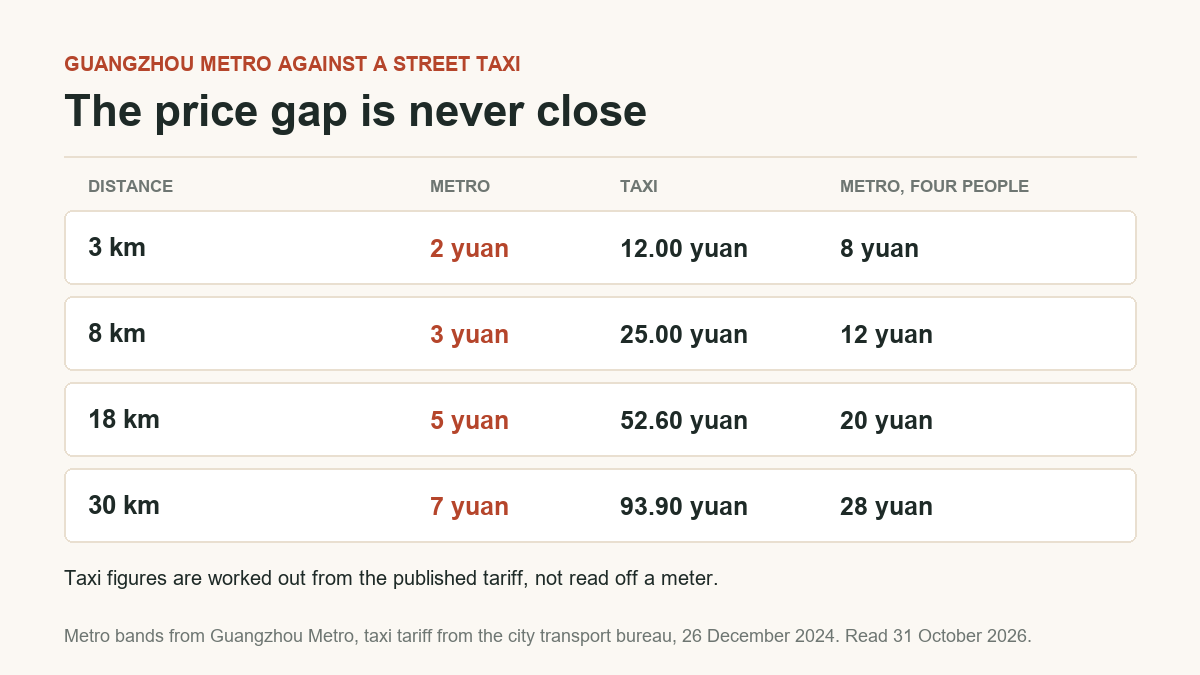
Short answer: take the metro. On price it wins at every distance and for every group size, and it is not close: a 3 km trip costs 2 yuan against a 12 yuan taxi flagfall, and even four people riding 18 km pay 20 yuan between them against about 52.60 yuan in one cab. The taxi only wins once price has stopped being the question, which means after the last train, before the first one, in heavy rain, with luggage, or on a trip so short that the walk to the station eats the saving.
This page is about that choice, not about what a ticket costs. The full fare bands, the payment methods and the 270 minute limit inside the paid area are on the Guangzhou travel guide, which covers the metro as part of a two day trip. If you have not used a Chinese metro before, the China metro guide covers the gates and the apps across every city.
A Guangzhou street taxi starts at 12 yuan for the first 3 km and then charges 2.6 yuan for each further kilometre; the tariff behind those two numbers is set out line by line in the next section. The metro starts at 2 yuan for the first 4 km and never costs more than 20 yuan for a single journey, per the Guangzhou government’s fare explanation, read 31 October 2026; the full bands live on the Guangzhou travel guide.
Every taxi figure on this page comes from one document: the notice on optimising and adjusting the fare of Guangzhou’s metered taxis, document number 穗发改规字〔2024〕9号, effective 30 November 2024 and valid for five years, read on the municipal government’s website on 31 October 2026. Its four operating rules, in the order a ride meets them:
App-based ride-hailing cars are not covered by this document at all. The notice prices metered taxis only, under the provincial pricing catalogue; ride-hailing fares are market-regulated, set platform by platform and moving by the hour, so no government-published price exists to quote and none is quoted here. When this page says taxi, it means the metered street taxi. The metro-versus-cab call comes up again when picking among the five day trips out of Guangzhou, and the same trade-off repeats at a larger scale when planning two days in Guangzhou.
Three rules in the taxi tariff push the two apart, and none of them is a surcharge a driver invents.
The taxi has no ceiling and the metro effectively never reaches one. The 20 yuan metro cap sounds like a limit that a long ride would hit. It is reached at 136 km of track distance: 6 yuan at 24 km from the first three bands, then fourteen further 1-yuan steps of 8 km each to hit the 20 yuan ceiling. No journey inside Guangzhou comes near that, so for a visitor the cap is not a constraint at all, and the metro fare stays in single figures while the taxi meter keeps climbing at 2.6 yuan a kilometre.
Distance above 15 km is charged twice. From 15 to 25 km the taxi adds 20 percent to the distance charge, and above 25 km it adds 50 percent. This is the return-empty fee, and it is the reason an airport run costs more than the arithmetic suggests. A 30 km trip is 93.90 yuan on the tariff before tolls.
Standing still costs 44 yuan an hour. When traffic drops below 10 km/h the meter switches to a waiting charge of 44 yuan per hour. On a normal street that is an irritation. On the approach to the Canton Fair complex during a session it is the difference between a 25 yuan ride and a 50 yuan one.
Between 23:00 and 05:00 the taxi adds 30 percent, but the rule is specific: it adds 30 percent to the distance charge, not to the flagfall. A ride of 3 km or less at midnight therefore still costs 12 yuan, because there is no distance charge to mark up. The surcharge only starts to bite once you are travelling far enough to be paying per kilometre.
The same notice, in force since 30 November 2024, introduced a floating band. The meter can run 10 percent above the base fare in the peak windows of 07:00 to 10:00 and 16:00 to 21:00, and between 10:00 and 16:00 it can run up to 30 percent below it. So the same trip at 11:00 and at 17:00 can be charged at genuinely different rates, and the cheaper window is the middle of the day, which is also when a visitor is most likely to be moving.
One more line worth knowing if you travel in February: during the Spring Festival holiday the taxi adds 10 yuan to every trip.
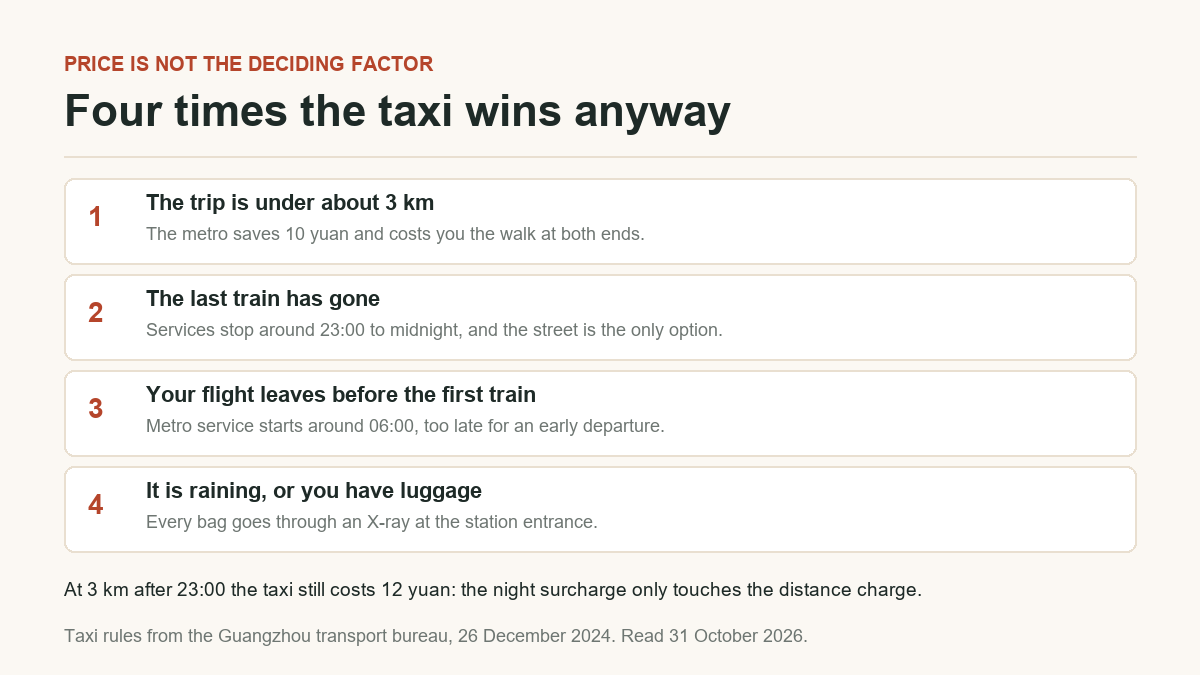
A trip under about 3 km. The metro saves you 10 yuan and costs you a walk at each end, plus the time to clear a ticket gate and find the right exit. Under 3 km the taxi is usually the better use of an hour, and the metro is not always faster once you count the walking.
After the last train. The operator publishes last-train times only on a page that fills itself in with a script, which could not be executed for this update, so no specific closing time is quoted here and none is estimated; check the official site for your own line before a late evening out. Past the last train the street is the only option, and the 30 percent night charge is simply the price of the hour.
Before the first train. First trains likewise vary by line, and the same rendering problem applies, so no opening time is quoted here either. A flight that boards at 07:30 is a taxi trip, and no amount of fare comparison changes it.
Rain and luggage. Every bag goes through an X-ray at the station entrance, which is fine with a daypack and slow with two suitcases at a busy interchange. In a summer downpour the case for standing under a station canopy rather than on a kerb is real but not absolute.
Most of the journeys where a visitor actually regrets the metro are not the ones where the fare was wrong. They are the ones that ended at 23:40 with two changes still to make. The useful habit is to check the last train for your final line before you go out, not after dinner, because the last train on a branch line leaves earlier than the last train on the trunk it connects to. That is the same rule that decides which day trips out of the city are worth attempting, and it is applied trip by trip on the Guangzhou day trips page.
The 270 minute limit inside the paid area works in the same direction. It is generous, and no sightseeing journey approaches it, but it does mean that a long evening spent inside a station complex counts against you. Wait outside the gates if you are not travelling.
Arithmetic first, from the two tariffs above and nothing else: four people taking one 3 km cab ride pay 12 yuan in total, 3 yuan each. The same four on the metro pay 2 yuan each, 8 yuan between them. The gap is 1 yuan per person, and what it buys is the walk to the station, the gate and the transfer, door to door. This is arithmetic, not a source, and it says nothing about time on purpose, because no official journey-time comparison exists to cite.
The instinct is that a group splits the cab fare and the metro multiplies. The arithmetic says otherwise, because the metro fare is so low that multiplying it four times still lands under the taxi. Four people travelling 18 km pay 20 yuan in total on the metro against about 52.60 yuan for the cab. Even at 30 km the group pays 28 yuan against 93.90.
What four people do buy with a taxi is one door-to-door movement instead of four people finding one exit, and that is a real thing on a tight schedule or in the rain. It is a time purchase, not a money one.
Terminal 2 has a metro station of its own, so the comparison there is straightforward: 7 yuan for a 30 km ride against 93.90 yuan plus tolls. Terminal 3 does not, and has not since 7 May 2026, when Terminal 1 closed and its metro station stopped accepting passengers. Reaching T3 by metro means Line 3 or Line 9 to Gaozeng, exit B, then a 2 yuan shuttle bus that takes about 15 minutes. For one person with a backpack that is still the sensible choice. For three people with suitcases at 05:00 it is not, and the taxi is doing something the metro cannot.
Three things would sharpen this page and are left out rather than estimated.
Yes, at every distance, and by a wide margin beyond about 5 km. Two people riding 8 km pay 6 yuan against 25 yuan.
The metro, if you are on your own and not carrying much: 7 yuan plus a 2 yuan shuttle to Terminal 3, or a direct ride to Terminal 2. The taxi becomes reasonable at three or more people with bags.
Only on the distance charge, which rises 30 percent between 23:00 and 05:00. A short ride under 3 km is still 12 yuan.
Travel between 10:00 and 16:00, when the meter can run below the base fare instead of above it.
Practical first-trip China guides — visas, VPN, eSIM, Alipay, trains, and city routes.