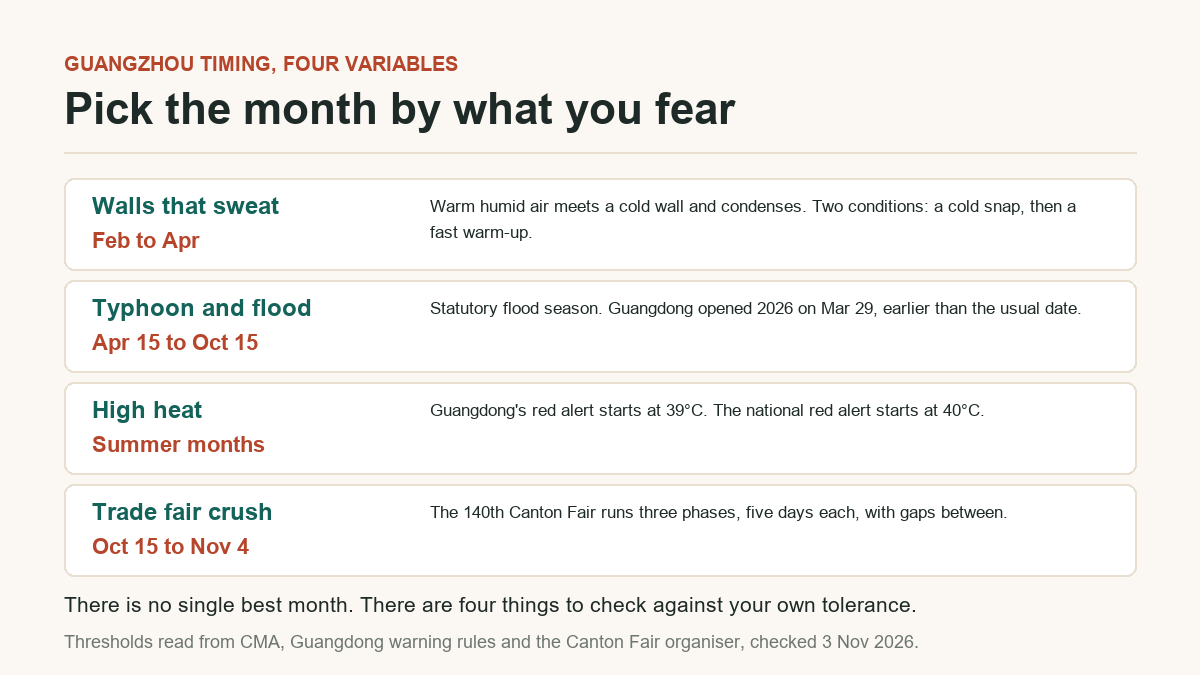
Four variables, four different kinds of answer
Only one of them is a date you can book against
Most “best time to visit” pages answer this with a month and a temperature range. Neither is available here in a form you can trust, because the two numbers that would make that answer work are the two nobody publishes on a schedule. So this page takes the question apart instead, and each half of the answer comes from a document you can go and read yourself.
The four variables are not the same kind of information, and that is the useful part. Condensation on your walls runs to a published month range but no calendar. The flood season has a legal start and end date, and it moved this year. Extreme heat has a temperature threshold but no month attached to it at all, because the heat alert is issued when the temperature crosses a line, not when a calendar says so. The Canton Fair is the only one of the four that publishes exact dates a year ahead, and it is therefore the only one you can plan a booking around.
February to April. A wall and floor problem, not a rainfall problem.
Two conditions have to line up: earlier cold air cools the indoor surfaces, then warm humid air arrives and condenses on them.
15 April to 15 October is the statutory flood season. In 2026 Guangdong opened it on 29 March.
The province can move that date, and it did. The typhoon warning system here has five levels, one more than the national four.
39 degrees Celsius is enough for a red alert in Guangdong. Nationally the red alert needs 40.
No month is attached to the heat alert. It is issued when the forecast crosses the line, so it is a booking risk rather than a calendar date.
15 October to 4 November 2026, in three phases of five days with gaps between them.
The only variable on this page with exact published dates, and the one that starts on the day the flood season ends.
Condensation on your walls is a mechanism, not a month of rain
The damp-wall season in southern China runs from February to April. Guangdong, Guangxi, Hainan and Fujian all get it. What is easy to get wrong is the cause. It is not rain soaking in from outside. The China Meteorological Administration describes it as warm humid air meeting a colder surface and turning into liquid water on it, the same principle as dew forming.
Two conditions have to hold at once. First, a spell of cold air has to cool the indoor surfaces properly, so the walls and floors are genuinely cold. Second, warm humid air has to arrive straight afterwards and warm the city up quickly. Skip either half and nothing happens: no cold snap means the walls were never cold enough, and no quick warm-up means the air stays dry.
That is also why it can be happening on a dry day. The weather station on the roof records no rain, the pavement outside is dry, and there is still water running down the inside of the window. The water is coming out of the air in the room. It often comes with fog and reduced visibility, and in bad cases there is standing water on the stairs and in the bathroom.
There is no official count of how many days it lasts, and no official threshold that switches it on. The published window is the month range and the physical mechanism, so treat February to April as the period to plan a dehumidifier or a room with less exterior wall in it, rather than as a forecast you can check.
Source: China Meteorological Administration explainer on the condensation season, published 15 March 2024, read 3 November 2026. The month range and the two conditions are quoted from that page.
The flood season has a legal start date, and in 2026 it moved
Guangdong’s flood season normally runs from 15 April to 15 October. That is not a weather forecast, it is the standing arrangement for the whole province: the flood control bodies go on round-the-clock duty for that window, and the provincial flood control headquarters can move the start and the end when the rains arrive early or when typhoon rain lingers past October.
For 2026 they moved it. The provincial flood control headquarters set the start of Guangdong’s flood season at 29 March, about two weeks ahead of the usual date, and their summary of the year was that the season would be earlier than usual, the total rainfall slightly above the historical average, the pattern front-loaded dry and back-loaded wet, and the number of typhoons close to normal but their intensity stronger than usual.
The national flood season date for the same year was 1 April, which matched the long-term average. So Guangdong was already inside its flood season at the point where the country as a whole was only just entering its own, which is exactly the sort of detail that gets lost when you read a national weather page instead of a provincial one.
The second thing to check in Guangdong is the typhoon warning system, because it does not match the national one. Guangdong issues five levels, white, blue, yellow, orange and red, adding a white level underneath the national set of four. White is the one worth understanding if you are booking trains and flights: it means a tropical cyclone may affect the area within 48 hours, which is your warning to change a booking before the city reacts. Yellow means the cyclone may hit within 24 hours with average winds of force 8 or gusts of force 9, and kindergartens and nurseries stop. Orange means within 12 hours, force 10 or gusts of force 11, and schools stop with residents advised to stay in. Red means force 12 or already there, and businesses and schools close apart from essential services.
For rain rather than wind, the provincial rainstorm alerts are graded on accumulation. The orange rainstorm alert means the local area has already had 50 millimetres of rain in the past three hours and it may continue. That is the number to watch if you are moving around the city on the day rather than booking months ahead.
Source: Flood season dates: Shenzhen Municipal Government knowledge base, information supplied by the Shenzhen Water Affairs Bureau, information date 6 January 2024, read 3 November 2026. The 2026 start date and the provincial summary: Guangdong Provincial Government portal, 2 April 2026, read 3 November 2026. Typhoon and rainstorm levels: Guangdong Meteorological Bureau warning signal guide, read 3 November 2026.
When a storm closes the city, it closes in writing, by the hour
This is the part that changes a plan rather than a mood. Guangzhou does not leave it to the weather. The city has a written shutdown order with five components, and the notice sets a specific time for each one, so the timetable below is a document you can read and a sequence you can plan around, not a description of how the city tends to behave.
The order in force when this was read came from the Guangzhou flood, drought and typhoon control headquarters, notified on 23 September 2025 and published by the Guangdong transport department the following day, still listed as in force. It stopped classes for the whole day, then stopped work at 19:00, then stopped shops, restaurants, parks and scenic areas at 21:00, and stopped the metro and buses, taxis and ride-hailing, and all other traffic, at midnight.
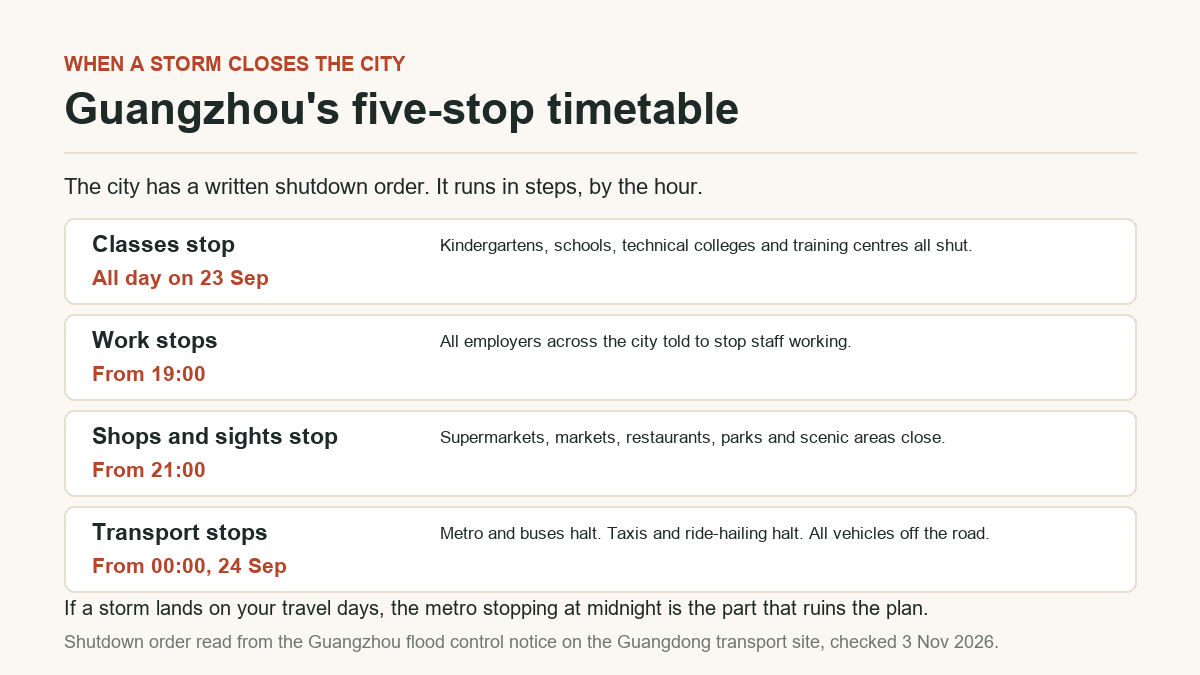
Two details in that sequence are worth more to a visitor than the rest. The first is that the metro stopping at midnight is a separate decision from the shops closing at 21:00, and it is the one that breaks itineraries. A visitor who finishes dinner at 21:30 still has transport. A visitor who finishes at 23:30 does not, and at that hour the only options are a long walk or a taxi that is also not running.
The second is that the hours come from one specific notice, and they are the hours for that notice. Another storm produces another notice with its own times. What generalises is the shape: classes first, then work, then commercial premises, then transport last, and transport last is what makes a stranded evening stranded.
Source: Guangzhou flood, drought and typhoon control headquarters notice of 23 September 2025, published 24 September 2025 on the Guangdong Provincial Transport Department site, file status in force, read 3 November 2026.
Two red heat alerts, two different numbers
Nationally the heat alert has three levels. Yellow means the daily maximum will sit above 35 degrees Celsius for three consecutive days. Orange means the maximum will rise to 37 degrees or more within 24 hours. Red means it will reach 40 degrees or more within 24 hours. The guidance attached to it is practical: keep out of the sun where you can, and specifically do not exercise or work outdoors between 10:00 and 16:00.
Guangdong runs its own heat alert alongside it, and its red threshold is lower. The provincial red alert means the maximum will reach 39 degrees within 24 hours, one degree below the national figure, and its instructions include stopping outdoor work altogether. So a forecast that sits at 39 degrees triggers the highest alert in Guangzhou and does not yet trigger the national one. If you are reading a national weather app, the provincial signal is the earlier warning.
Notice what is missing. No month is attached to the heat alert anywhere in these documents, and this page will not invent one. The alert is issued when a temperature crosses a threshold, which means heat is the one variable here you cannot resolve on a calendar in advance. What you can do is know your threshold: red at 39 means an outdoor day is officially over, and if the ordinary advice of staying off the pavement between 10:00 and 16:00 already sounds like a bad plan, the season you choose matters more than any one date in it.
Source: National heat alert levels and the outdoor activity guidance: China Meteorological Administration warning explainer, published 20 May 2022, read 3 November 2026. Provincial red threshold at 39 degrees: Guangdong Meteorological Bureau high temperature warning guide, page dated 23 August 2018, read 3 November 2026.
The trade fair is the one variable with dates, and it starts the day the flood season ends
The 140th Canton Fair runs in three phases of five days each: 15 to 19 October, 23 to 27 October, and 31 October to 4 November 2026. The organiser’s own published schedule shows a gap between each phase and between the second and third, so the pattern is three busy weeks with quieter weeks in between rather than one continuous run.
Two things about that timing matter for this page. The first is that the fair opens on 15 October, which is the same day the statutory Guangdong flood season ends, and the third phase runs into November, a month after the season is over. The fair sits on the boundary of the flood season rather than inside the middle of it, which is a different thing from saying the fair weeks are dry. It means the two things you are weighing against each other are not the same thing, and a schedule that treats autumn as one block is hiding that.
The second is what this page will not tell you. The organiser’s site currently carries the 140th session only, so there is no published date here for the spring 2027 session and this page does not carry one. The phase-by-phase breakdown, what each phase covers and how a visitor gets a badge are all on the Canton Fair dates page. What belongs here is only the timing: three weeks of five days each, with gaps, and a start date that lands exactly on the flood season’s last day.
If you are not in the city for trade, the three phase weeks are the expensive, crowded part of the autumn, and the gaps between them are the weeks to be walking around Haizhu and the old city. If you are in the city for trade, none of this applies to you, and you should be reading the fair page instead. Either way the fair is the only variable on this list you can put in a calendar a year ahead, so it is the one that should decide the dates first, with the other three checked against whatever it leaves you.
Source: Phase names and dates for the 140th session: the Canton Fair organiser’s own published schedule interface, read 3 November 2026.
Choose by your own tolerance
Pick the variable you cannot live with
This is the decision, laid out as one row per thing you might be trying to avoid. The last column is the signal to watch, because three of the four do not arrive as a date you can see coming.
| What worries you | The window to watch | The signal to watch for it |
|---|---|---|
| Water on the walls and floors | February to April | No signal. A cold snap followed by a fast warm-up is what creates it. |
| Typhoons, flooding, cancelled trains | 15 April to 15 October by statute; 29 March to 15 October in 2026 | The white typhoon signal, at 48 hours of notice |
| Heat you cannot walk in | No month. It is issued on a temperature crossing. | Red alert at 39 degrees in Guangdong, against 40 nationally |
| Crowds and higher room rates | 15 October to 4 November 2026, in three phases | Published a year ahead, so this one you can plan around |
If none of the four is a problem for you, then the part of the calendar these four published windows do not cover runs from the start of November to the end of January. That is not a claim about the weather. It is simply what is left once you cross four published windows off the year.
What I did not verify
Room rates for the Canton Fair weeks were not checked for this page, so nothing here quotes a price for that period. The figures other pages give for monthly average temperatures and monthly rainfall for Guangzhou were not used either, because a monthly average with no stated source and no stated reading date is a number you cannot act on. How long the condensation season lasts in a given year is not published anywhere I could find, so the page gives the month range and the mechanism and stops there.
There are no dates here for the spring 2027 Canton Fair, because the organiser has not published them. And nothing on this page is a first-hand report of a storm or a wet wall. The numbers are read from documents, and the documents are named with the date each one was read.
Source: Read on 3 November 2026 for every source named on this page.
Where these numbers come from
| Figure used on this page | Source type | Read on |
|---|---|---|
| Condensation season months, its two conditions and the mechanism | China Meteorological Administration explainer, published 15 March 2024 | 3 Nov 2026 |
| Statutory flood season 15 April to 15 October | Shenzhen Municipal Government knowledge base, information supplied by the Shenzhen Water Affairs Bureau, information date 6 January 2024 | 3 Nov 2026 |
| 2026 flood season start of 29 March, national date of 1 April, rainfall and typhoon summary | Guangdong Provincial Government portal, 2 April 2026 | 3 Nov 2026 |
| Five typhoon levels and the 48-hour white signal, orange rainstorm at 50 millimetres in three hours | Guangdong Meteorological Bureau warning signal guide | 3 Nov 2026 |
| Shutdown order and its times for classes, work, shops and transport | Guangzhou flood, drought and typhoon control headquarters notice of 23 September 2025, published on the Guangdong Provincial Transport Department site, file status in force | 3 Nov 2026 |
| National heat alert at 35, 37 and 40 degrees, and the 10:00 to 16:00 guidance | China Meteorological Administration warning explainer, published 20 May 2022 | 3 Nov 2026 |
| Guangdong red heat alert at 39 degrees | Guangdong Meteorological Bureau high temperature warning guide, page dated 23 August 2018 | 3 Nov 2026 |
| Canton Fair phase names and dates for the 140th session | Canton Fair organiser’s own published schedule interface | 3 Nov 2026 |
Every one of these is a document, not an aggregation, and each was opened on the day named. For what to do once you have picked a month, the Guangzhou travel guide has the transport and the sights, the Guangzhou day trips page covers the days you can spend outside the city, and the Guangzhou metro and taxi page covers how you get around it. For the national picture, the China by month guide puts Guangzhou in the context of the rest of the country.