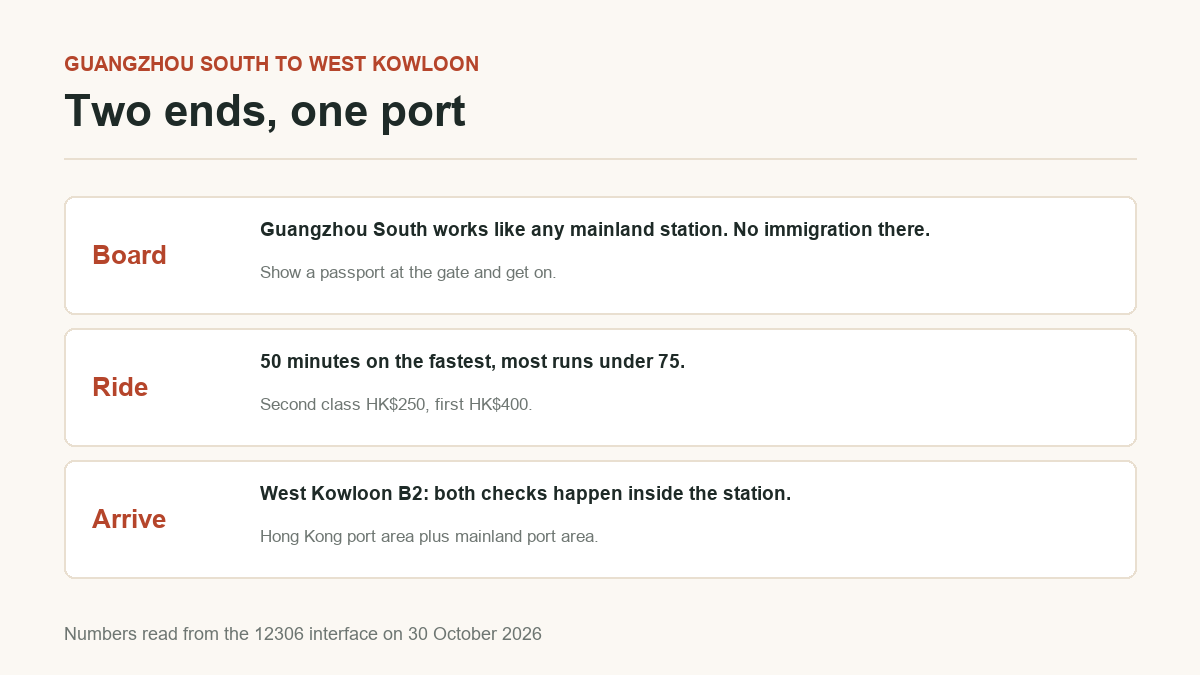
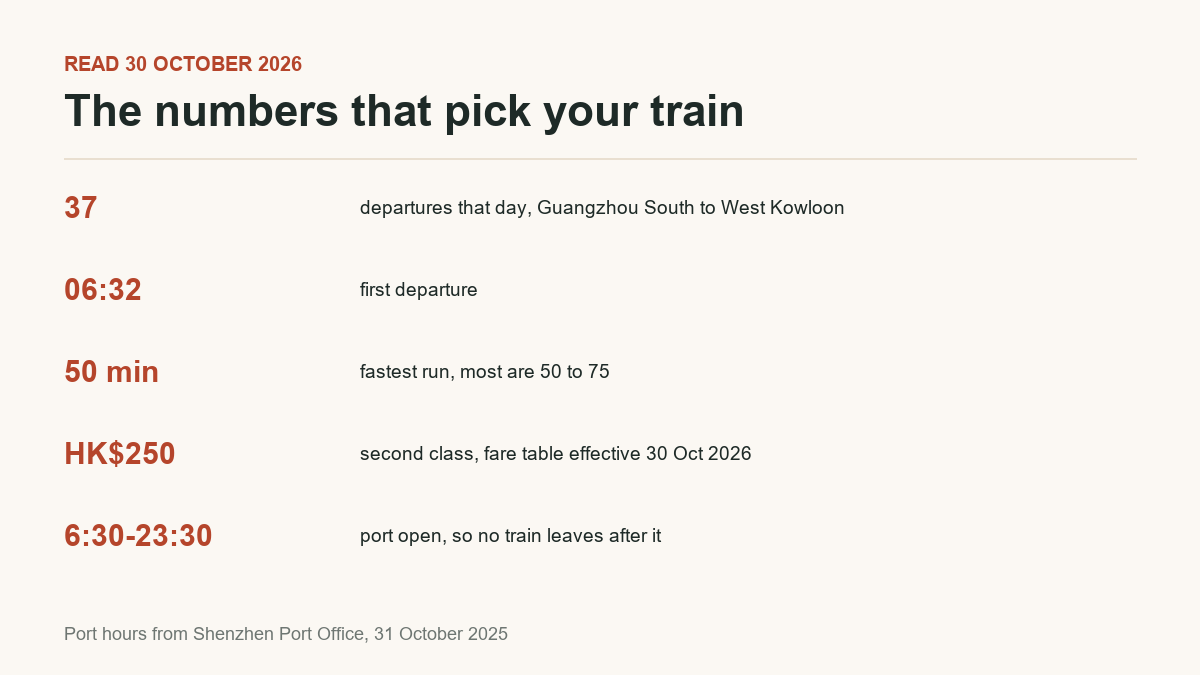
Short answer: take the train from Guangzhou South to West Kowloon. On 30 October 2026 that pair ran 37 departures, the first at 06:32, the fastest at 50 minutes, and second class cost HK$250 on the fare table in force that day. All of the immigration happens at the West Kowloon end, inside the station, because the mainland port area sits in the same building as the Hong Kong one. You board at Guangzhou South like any domestic train and you do not see a border officer until you are already in Hong Kong.
Every number on this page is for Guangzhou South to West Kowloon. Guangzhou has more than one station and the names on a booking site do not always make the difference obvious, so check the departure station before you pay. A train leaving from a different Guangzhou station is a different journey, and the stations are not walking distance apart.
West Kowloon is the only station on the Hong Kong side, so the arrival half of the booking is never ambiguous. If the arrival says anything other than West Kowloon, you are not looking at this train.
| What | Number | Read on |
|---|---|---|
| Departures that day, Guangzhou South to West Kowloon | 37 | 30 October 2026 |
| First departure | 06:32 | 30 October 2026 |
| Fastest run | 50 minutes | 30 October 2026 |
| Most runs | 50 to 75 minutes | 30 October 2026 |
| Port open | 06:30 to 23:30 | 31 October 2025 |
The port hours are the wall behind the timetable. The immigration halls inside the station open at 06:30 and close at 23:30, so a departure cannot sit outside that window. I did not pull the last departure time out of the ticketing interface on the day I checked, so I am not going to print one here.
| Class | Adult fare |
|---|---|
| Second | HK$250 |
| First | HK$400 |
| Premium | HK$450 |
| Business | HK$750 |
These are the figures on the fare table effective 30 October 2026. The tickets are priced in renminbi and the Hong Kong dollar figure is adjusted with the exchange rate each month, so what you pay depends on the month you buy in. That is the mechanism, not a promotion, and it is why a price copied from a post written last year can be a few percent out without anyone being wrong.
The full fare and frequency table for this corridor lives in the Guangzhou travel guide, so this page does not print it twice. What this page does that the guide cannot is the part below.
West Kowloon is four floors underground. B1 is the ticketing hall, B2 is arrivals, B3 is departures and B4 is the platforms. The port is not a separate building you walk to before or after the train: the Hong Kong port area and the mainland port area are both inside the station, and each side runs its own checks under its own law. In the words of the Shenzhen Port Office, the station has a Hong Kong port area and a mainland port area and clears passengers under the co-location model, with each side enforcing its own rules. The Hong Kong Immigration Department lists West Kowloon as the second control point in Hong Kong to use co-location.
The sizes are worth knowing because they explain the queue behaviour. The mainland port area is about 109,000 square metres, with 50 self-service channels and 16 staffed channels in each of the arrival and departure halls. The Hong Kong government’s area is about 24,700 square metres, with 44 staffed counters and 41 self-service lanes on arrival, and 32 counters and 31 lanes on departure. The station is designed for 200,000 crossings a day. A design figure is not a wait time, so treat it as scale rather than a forecast.
Three practical details that only show up on the official pages:
Direction matters more than most guides admit. Going south, you clear both sides at West Kowloon and walk out into Kowloon. Coming north, the same building works as an entry point into mainland China: since 5 November 2025 West Kowloon has been one of the ports where the 240-hour visa-free transit policy can be used to enter the country. The National Immigration Administration added five ports next to Hong Kong and Macao that day, taking the total from 60 to 65.
That is the fact that changes an itinerary. If you fly into Hong Kong and want to reach the mainland without a second flight, the train is the entry, not a connection after it. Eligibility depends on your nationality and on the onward ticket you hold, and the transit policy has its own page here: China 240-hour visa-free transit.
Four things are missing on purpose rather than by accident. The last departure time of the day was not in the data I pulled, so it is not printed. The real queue length at the port on a public holiday is unknown to me: the 200,000 figure is a design capacity, not an observed wait. Whether this train sells out during Canton Fair weeks is also unchecked, and the same goes for the booking flow on the operator’s own site, which I did not walk through.
What I can say is that the timetable is dense enough that a missed train is an inconvenience rather than a day lost, which is not true of the cross-border buses.
If you are comparing the two southern crossings, the Guangzhou to Shenzhen train page covers the 29 minute version and the station pair that decides it. For the city itself, start with the Guangzhou guide. For the other side of the border, Hong Kong things to do picks up where the train drops you. If this is your first rail trip in the country, the high-speed rail guide covers ticketing and stations, and the city guides hub has the rest of the map.
Sources: departure count, first train, run times and fares from the 12306 ticketing interface, read 30 October 2026. Port hours, floor layout, channel counts and the exchange shop from the Shenzhen Port Office page on West Kowloon, published 31 October 2025. Co-location status from the Hong Kong Immigration Department. The 240-hour transit port addition from the National Immigration Administration, read 3 November 2026.
Practical first-trip China guides — visas, VPN, eSIM, Alipay, trains, and city routes.